

Release Date: September 1991 Developer: MicroProse
In the early 1990s, the landscape of strategy gaming was dominated by flight simulators and hex-based wargames that focused on specific battles or skirmishes. Then came Sid Meier’s Civilization, a game of such staggering ambition that it didn’t just want you to win a battle—it wanted you to guide the entire human race from the invention of the wheel to the colonization of Alpha Centauri. More than three decades later, the “One More Turn” phenomenon it birthed remains the gold standard for the 4X genre: eXplore, eXpand, eXploit, and eXterminate.

A Sandbox of Human History
Civilization begins in 4000 BC with a single, humble settler unit standing in a vast, black-shrouded wilderness. From this moment, every decision ripples through the millennia. Do you settle on the coast for future trade, or near the mountains for defensive bonuses and production?
The brilliance of the original Civ lies in its Tech Tree. This web of interconnected discoveries—starting with Alphabet or Pottery and ending with Nuclear Fission—is more than just a progression system; it is a narrative engine. Every time a pop-up appears announcing you have discovered “The Republic” or “Gunpowder,” the rules of your world shift. You aren’t just gaining stats; you are evolving your society.
Diplomacy and the “Nuclear” Gandhi
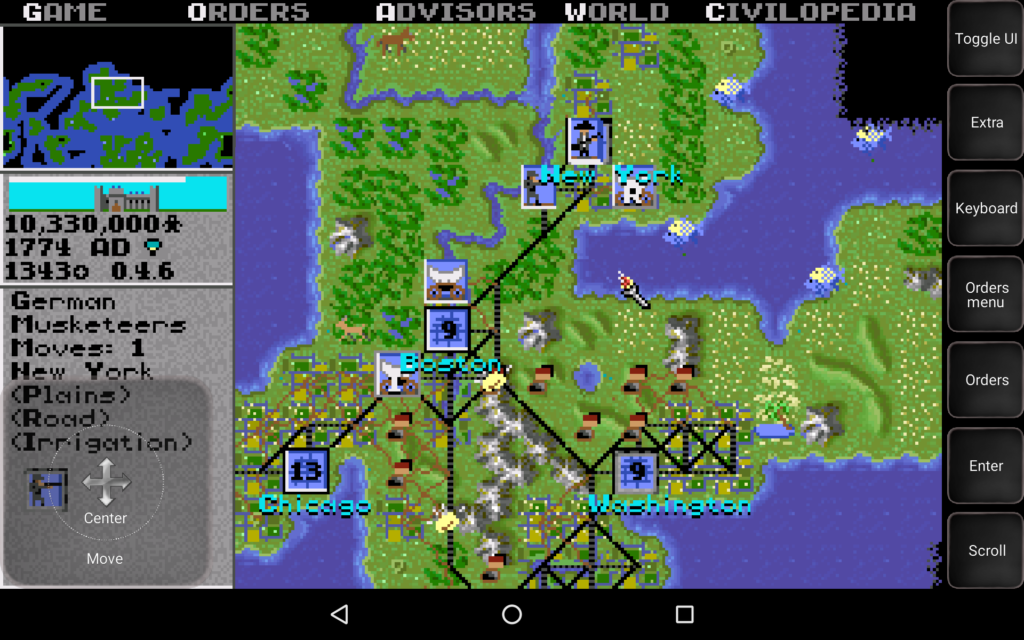
While the graphics were primitive by today’s standards—composed of simple 16-color EGA or 256-color VGA tiles—the personalities of the AI leaders made the world feel alive. Meeting Julius Caesar or Elizabeth I for the first time was a tense diplomatic dance.
Interestingly, the first game birthed one of gaming’s most famous urban legends: “Nuclear Gandhi.” Due to a logic bug in how aggression levels were calculated, the peaceful Indian leader would occasionally become a warmongering tyrant upon adopting Democracy, threatening players with atomic fire. Whether a myth or a glitch, it highlighted how much character Sid Meier and Bruce Shelley managed to pack into a few kilobytes of code.
The Balancing Act
The gameplay is a constant, exquisite agony of choice. Your cities need to grow, which requires Irrigation, but they also need to build, which requires Mines. If you focus too much on science, a neighboring empire might steamroll your defenseless scholars with Chariots. If you focus too much on the military, your economy will collapse, or your citizens will revolt.
Managing the “Three Sliders” (Tax, Science, and Luxuries) was the core of the strategy. It required a level of micromanagement that felt deeply rewarding; seeing a tiny tribe turn into a global superpower with railroads and spaceships provided a sense of “God-game” satisfaction that few titles since have replicated.

A Legacy That Never Ends
It is easy to look at the original Civilization and see only the clunky interface and 1991-era sprites. However, beneath that dated exterior beats the heart of a perfect strategy game. It taught us that history isn’t just a series of dates, but a series of choices. It showed us that a game could be both a grand military epic and a thoughtful exploration of sociology and economics.
Even today, as we look toward Civilization VII, the DNA of that 1991 masterpiece is clearly visible. It remains a testament to the fact that great design is timeless. If you have never played the original, it is worth a journey back to 4000 BC—just be prepared to greet the daybreak after a night long gaming session. After all, what’s one more turn?