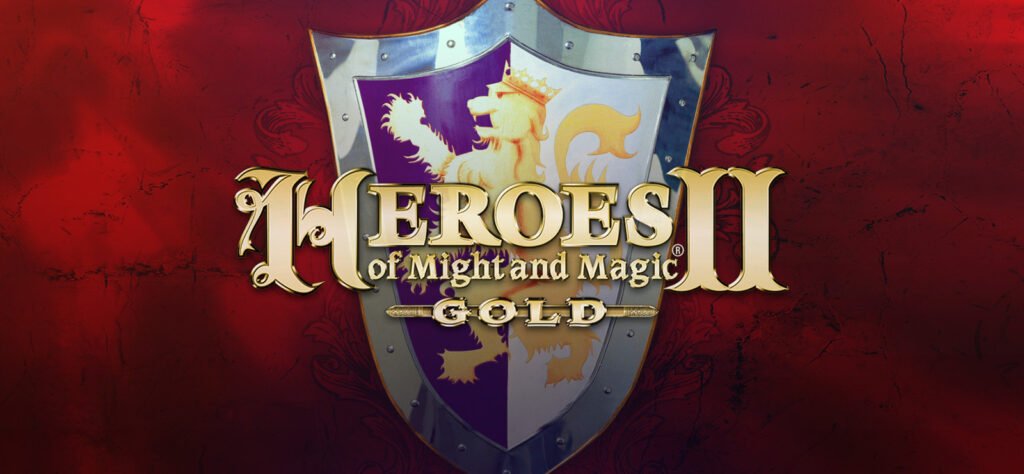

Release Date: October 1, 1996 (North America) Developer: New World Computing
Get It On: GOG
If you spent any part of the late 90s hunched over a beige CRT monitor while your parents yelled at you to get off the phone line, the triumphant MIDI trumpets of Heroes of Might & Magic II (HoMM2) are likely burned into your soul.
Released in 1996 by the legends at New World Computing, The Succession Wars wasn’t just a sequel; it was the moment this series graduated from a quirky experiment into a titan of the strategy genre. Even now, in 2026, when we have photorealistic graphics and VR, there is something about this specific entry that feels like digital comfort food. It is the “just one more turn” game that started it all for many of us.
The Aesthetic: A Living Storybook
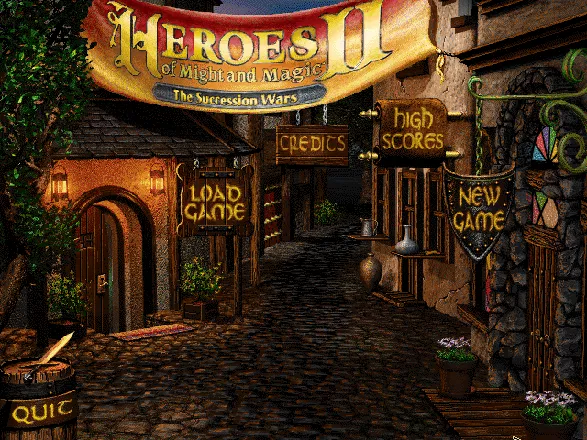
Let’s start with the visuals, because HoMM2 is arguably the best-looking game in the entire franchise. While Heroes III (the fan favorite) went for a more grounded, gritty fantasy look, and later entries stumbled into clunky 3D, Heroes II is a vibrant, hand-drawn masterpiece.
Every town screen is a literal work of art. When you click on the Sorceress’s castle, you aren’t just looking at a menu; you’re looking at a shimmering lakeside retreat with rainbows and sparkling towers. The Necromancer’s lair feels appropriately gloomy and gothic without being “edgy.” The sprites on the battlefield have a chunky, whimsical personality—from the way a Griffin flutters its wings to the hilarious “thwack” of a Troll throwing a rock.
And we cannot talk about the vibe without mentioning the Opera. Yes, actual operatic vocals in a 1996 strategy game. Each town has its own theme, and the music makes a simple task like upgrading your pig farm feel like a climactic moment in a Wagnerian epic.
The Gameplay: Simple, Addictive, and Ruthless
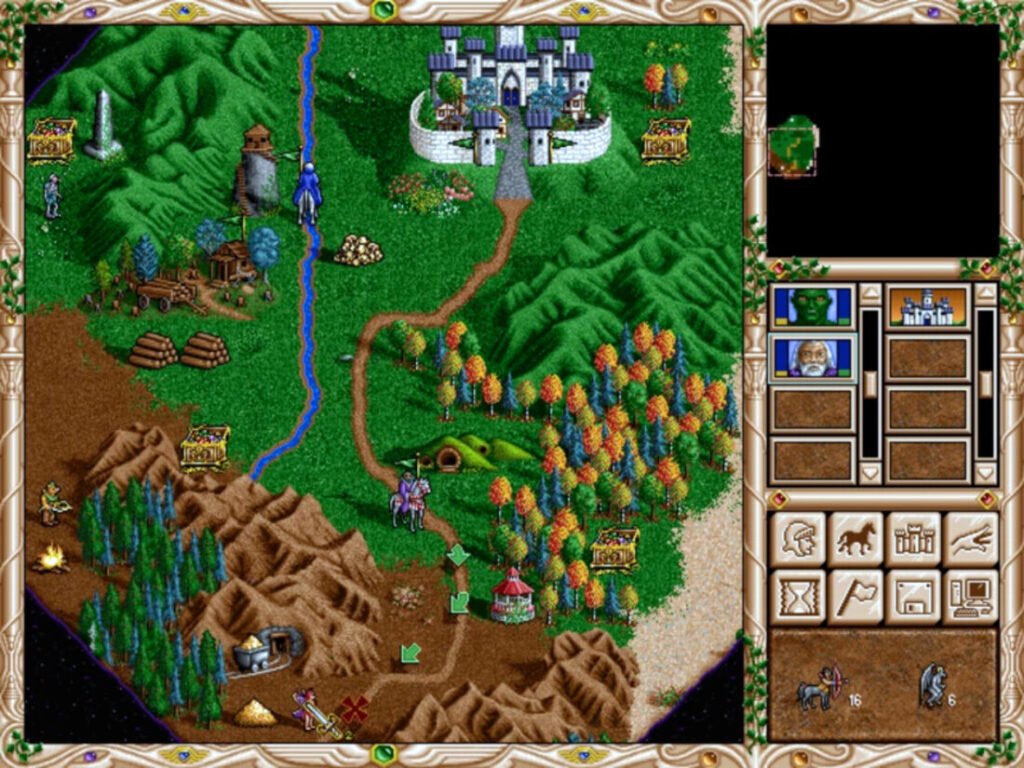
The core loop of HoMM2 is the gold standard for turn-based strategy. You start with a Hero, a handful of low-tier troops (shoutout to the Peasant, the most useless unit in gaming history), and a fog-covered map.
Your goals are simple but the execution is stressful:
- Exploration: You need to flag mines to get resources like Wood, Ore, and the “precious” materials (Mercury, Sulfur, Crystal, and Gems).
- Expansion: You have to decide—do I build the Mage Guild today to get better spells, or do I save my gold to recruit Ogres so I don’t get bullied by the local wandering monsters?
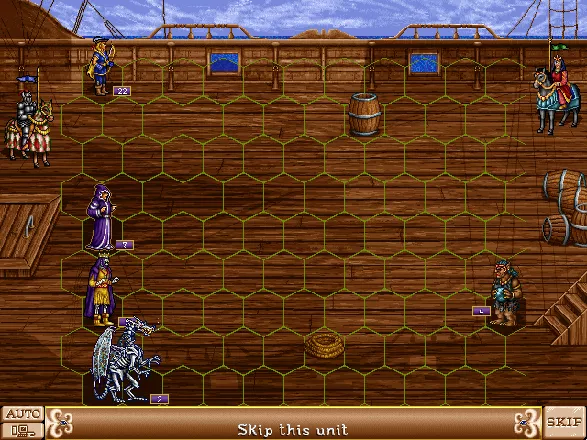
- Conquest: Eventually, you’ll bump into an enemy Hero who has been doing the exact same thing, and that’s when the tactical hex-grid combat kicks in.
The beauty of Heroes II is that it introduced Secondary Skills. This was the game-changer. Suddenly, your Hero wasn’t just a stat-stick; they were a specialist. You could learn Logistics to move further across the map, Necromancy to turn your fallen enemies into a massive stack of skeletons, or Wisdom to learn high-level world-ending spells.

The Balance (Or Lack Thereof)
Is Heroes II perfectly balanced? Absolutely not. If you play as the Knight, you’re basically playing on “Hard Mode” because your units are mostly dudes with swords who get eaten by dragons. If you play as the Warlock or the Wizard, you are aiming for the “nuclear option”—the Black Dragon or the Titan.
There is a specific kind of dopamine hit that only comes from finally upgrading your Dragon Tower and realizing that you now own a unit that is immune to magic and can fly across the entire screen to incinerate your rival. It’s glorious, it’s unfair, and it’s exactly why we love it.
The Story: A Family Feud for the Ages
The campaign follows the “Succession Wars” between two brothers: the “good” Roland and the “evil” Archibald. What made this cool back in the day was the choice. You could choose which brother to support, leading to different missions and endings.
Archibald was always the cooler choice, let’s be honest. He had the better castle, the better units, and he looked like a classic Saturday morning cartoon villain. The game didn’t just give you a map; it gave you a reason to hate the guy on the other side of the border.
Why We’re Still Talking About It
You might wonder why anyone would play this when Heroes of Might & Magic III exists. While III is technically a bigger and “better” game, Heroes II has a soul that is hard to replicate. It feels like a fairy tale. It’s less cluttered, the colors are brighter, and the power scaling feels more dramatic.
It’s also surprisingly accessible. You can pick up the “Gold” version of the game today on GOG or Steam, and with the fheroes2 (Free Heroes 2) engine—a fan-made project that updates the game for modern monitors—it runs like a dream. It’s the perfect game to play on a laptop while sitting on the couch, or even on a handheld device.
Heroes of Might & Magic II is a masterpiece of the “Golden Age” of PC gaming. It hits that perfect sweet spot between tactical depth and pure, unadulterated fun. It’s a game where you start playing at 8:00 PM, and suddenly it’s 3:00 AM, you’ve forgotten to eat, and you’re intensely debating whether you should spend your last 2,000 gold on a Genie or a new boat.
It’s timeless, it’s beautiful, and it’s a reminder that sometimes, the old ways are the best ways.