


Release Date: February 9, 1999 Developer: Firaxis Games
Get It On: GOG
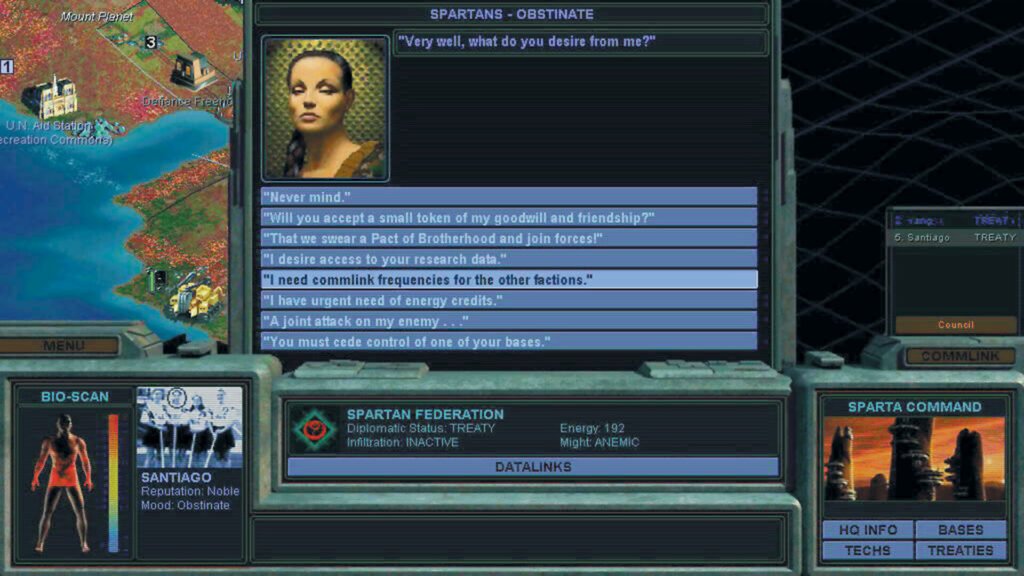
When people talk about the “Golden Age” of strategy games, they usually point toward the late nineties. It was a time when pixels were chunky, manual booklets were thick enough to stop a bullet, and Brian Reynolds and Sid Meier were busy crafting what many still consider the greatest 4X strategy game ever made. I’m talking, of course, about Sid Meier’s Alpha Centauri (SMAC). Released in 1999 as a spiritual successor to the Civilization series, it didn’t just iterate on the formula of building cities and moving units; it reinvented the soul of the genre. While modern games have flashier graphics and more streamlined interfaces, SMAC remains the undisputed heavyweight champion of atmosphere, narrative, and philosophical depth.
The Great Leap into the Unknown
The premise starts where a typical game of Civilization ends. Humanity has finally built a colony ship, the Unity, and launched it toward the Alpha Centauri system. But this isn’t a triumphant Star Trek voyage. Mid-transit, a reactor malfunction wakes the crew early, the captain is assassinated, and the mission leadership fractures into seven distinct ideological splinter groups. As the ship breaks apart in orbit of “Chiron” (the planet’s actual name, though everyone just calls it Planet), these factions land in different pods, scattered across a hostile, alien world.
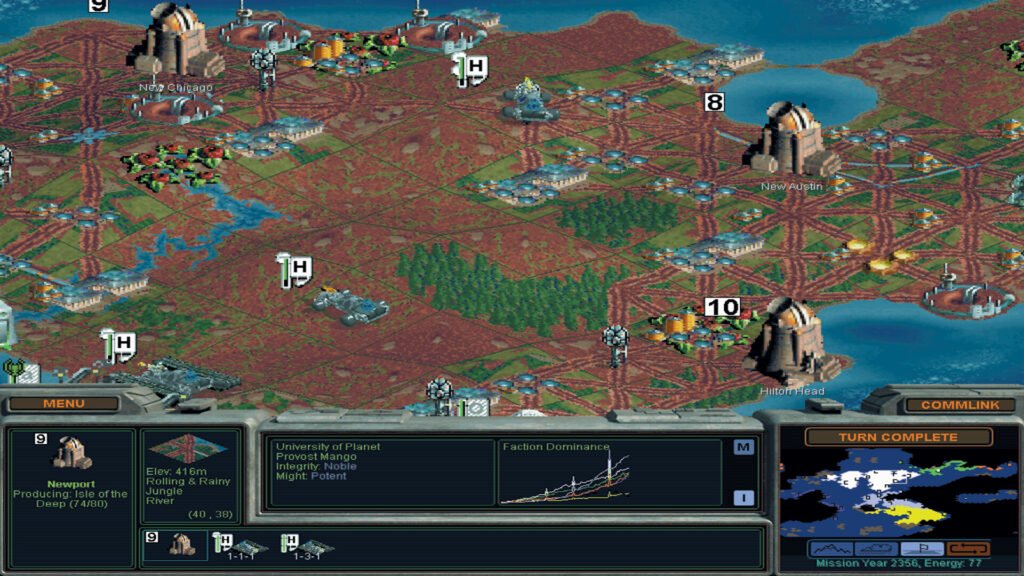
From the moment you hit the surface, you realize this isn’t Earth. The ground is covered in a terrifying, sentient red fungus. Mind worms—psychic leeches that lay eggs in your colonists’ brains—burrow out of the soil. The environment itself is a character, one that reacts to your pollution and your very presence. You aren’t just racing against other humans; you are trying to survive a planetary ecosystem that might actually be awake and deeply annoyed by your arrival.
The Factions
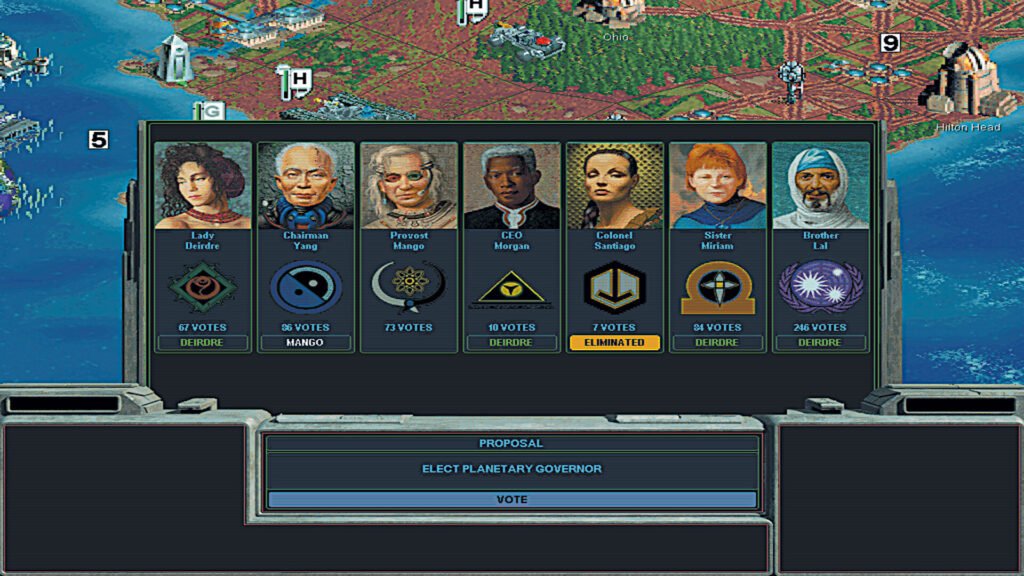
What truly sets SMAC apart from its peers is its roster of leaders. In most strategy games, factions are defined by dry bonuses like “+10% Gold” or “Faster Ships.” In Alpha Centauri, factions are defined by their souls.
- Gaia’s Stepdaughters (Lady Deirdre Skye): The environmentalists of the group. They focus on “Green” economics, capturing native mind worms to use in battle, and living in harmony with the planet’s ecology.
- Morgan Industries (CEO Nwabudike Morgan): The ultimate capitalists. They receive massive economic bonuses but struggle with environmental regulations and support smaller populations due to their lavish lifestyles.
- The Human Hive (Chairman Sheng-ji Yang): A terrifying collectivist state where the individual doesn’t exist. They excel at rapid growth and building “brutalist” infrastructure, ignoring the needs of the citizens for the good of the state.
- The Lord’s Believers (Sister Miriam Godwinson): Religious fundamentalists who are suspicious of high technology. They get massive combat bonuses when attacking and are resistant to brainwashing, making them a nightmare to fight in the early game.
- The University of Planet (Academician Prokhor Zakharov): Brilliant scientists who prioritize research above all else. They discover technologies at a blistering pace but are vulnerable to corporate espionage and drone riots.
- The Spartan Federation (Colonel Corazon Santiago): A survivalist society that believes in strength above all. Their units are highly disciplined and better trained right out of the gate, making them the premier military power.
- Peacekeeping Forces (Commissioner Pravin Lal): The remnants of the original UN mission. They are the diplomats of the bunch, drawing in more people to their cities and exerting more influence in the Planetary Council.
The Voice of the Future
One of the most immersive features of the game is the way it delivers its technology tree. In Civilization, researching “Gunpowder” gives you a pop-up and a stat boost. In SMAC, researching a tech like “Neural Grafting” or “Social Psych” rewards you with a voiced quote from one of the faction leaders. These quotes are hauntingly well-written, ranging from snippets of poetry to cold, Machiavellian observations on the nature of power. Hearing Chairman Yang calmly explain why “the individual is a fiction” while you unlock a new way to oppress your citizenry adds a layer of narrative weight that most modern games can’t touch. It turns the tech tree into a philosophical journey, tracking humanity’s slow descent into either transcendence or total madness.
Building Your Own Nightmare (or Utopia)
The gameplay mechanics were ahead of their time, introducing features that the main Civilization series didn’t adopt for over a decade. The unit workshop allowed you to custom-design your military, choosing the chassis, the weapon system, the armor, and special abilities. If you wanted a fast-moving scout with psychic shielding to fight mind worms, you could build it. If you wanted a massive, slow-moving terraforming ship that could raise entire mountain ranges from the sea, that was an option too. The 3D terrain was also a massive leap forward; elevation actually mattered, affecting combat and rainfall. You could literally use terraformers to raise a ridge of mountains to block the rain clouds from reaching your rival’s territory, effectively turning their lush jungle into a barren desert. It was a level of “environmental warfare” that felt truly god-like.

The Sentient World and the Endgame
As the game progresses, the “Mind Worms” and the “Xeno-fungus” stop being mere nuisances and start feeling like the immune system of a living entity. The narrative suggests that Planet is a nascent intelligence, and your arrival is either a catalyst for its birth or a parasite it needs to purge. The endgame isn’t just about conquering everyone or launching another ship; it’s often about “Transcendence”—merging human consciousness with the planetary nervous system. It’s a heady, sci-fi concept that feels earned after hundreds of turns of fighting, building, and debating. Unlike the often-tedious “click next turn” slog of most strategy endgames, SMAC’s finale feels like a genuine climax to a grand epic.
A Legacy That Refuses to Fade
Despite a 2014 attempt at a spiritual successor with Civilization: Beyond Earth, nothing has quite captured the lightning in a bottle that is Alpha Centauri. Beyond Earth had the polish, but it lacked the grit, the terrifying atmosphere, and the unforgettable personalities of the original seven leaders. SMAC thrives on its limitations; the low-fidelity art forces your imagination to fill in the horrors of the fungus and the majesty of the Monoliths. It’s a game that asks you hard questions: Is freedom worth the chaos? Is order worth the tyranny? Can humanity ever truly change, or are we doomed to carry our old grudges to the furthest reaches of the galaxy? Decades later, the voice of Commissioner Lal still echoes in the minds of players, reminding us that “the stars are not for man.” But as long as we have a copy of this game, we’ll keep trying to prove him wrong.