

Release Date: February 1997 Developer: MicroProse
In the mid-nineties, if you wanted to play Magic: The Gathering, you had to physically locate another human being, sit across from them at a kitchen table or a cramped backroom of a hobby shop, and hope they didn’t spill a soda on your Black Lotus. This was the era of the physical card game’s meteoric rise, a time when the “Gathering” part of the title was a literal requirement. Then came MicroProse. Known primarily for deep strategy epics like Civilization, MicroProse took the complex, math-heavy mechanics of Richard Garfield’s masterpiece and shoved them into a computer. The result was a game simply titled Magic: The Gathering, though fans affectionately refer to it today as “Shandalar.” It remains, even decades later, one of the most immersive and weirdly perfect translations of a card game to a digital format.
What made the 1997 release so special wasn’t just that it let you play Magic against a computer—though in an era of dial-up internet, that was a godsend. It was the fact that MicroProse didn’t just build a card simulator; they built an entire open-world Role Playing Game (RPG) around the cards. They understood that the flavor of Magic—the wizards, the mana, the planeswalking—was just as important as the stack and the phases of a turn. When you booted up the game, you weren’t just clicking through a menu of decks. You were a nameless wizard dropped into the world of Shandalar, tasked with stopping five evil mages from summoning an entity known as Arzakon. It was ambitious, buggy as a swamp in summer, and utterly brilliant.

The Magic of the Overworld
Walking through the world of Shandalar felt like playing a high-stakes version of Zelda mixed with a deck-builder before “deck-builder” was even a genre. You started with a weak, mono-colored deck of mostly “junk” cards—think Ironroot Treefolks and Gray Ogres—and wandered a pixelated landscape. As you traveled, you would encounter wandering monsters, from lowly bandits to terrifying vampires. Bumping into an enemy triggered a duel. If you won, you might win a few cards for your collection or gold to spend at local villages. If you lost, the enemy would take one of your precious cards. This created a sense of genuine peril that modern digital card games, like Magic: The Gathering Arena, simply cannot replicate.
The progression loop was incredibly satisfying. You would venture into dungeons where the rules of the game might change—perhaps every creature gets +1/+1, or players start with extra life—to find “Power Nine” cards like the Moxen or the Ancestral Recall. There was something inherently magical about “earning” a card that would cost thousands of dollars in real life by defeating a digital Lich in a pixelated castle. You weren’t just a player; you were a scavenger in a world where knowledge and power were literally represented by pieces of cardboard.

A Masterclass in Atmosphere
The aesthetics of the 1997 game are steeped in that specific brand of 90s fantasy grit. The music was atmospheric and often eerie, shifting based on which terrain you were traversing. If you were in the forest, the flutes were whimsical; if you entered a swamp, the percussion became heavy and dread-inducing. The interface, while clunky by today’s standards, felt tactile. You could see your hand of cards splayed out at the bottom of the screen, and the sound of a card being played—a satisfying “thwack”—is burned into the memory of everyone who played it.
Perhaps the most impressive feat was the AI. Programming a computer to play Magic: The Gathering in 1997 was an monumental task. Magic is a game of infinite variables, bluffing, and complex timing. While the “Sidle” AI (as it was called) certainly made some boneheaded moves—like Lightning Bolting its own creature for no reason—it was surprisingly competent at using the cards available at the time. It gave solo players a way to test decks and learn the intricacies of the “Old School” card pool, covering sets from Limited Edition Beta through the Dark.

The Legacy of the Astral Set
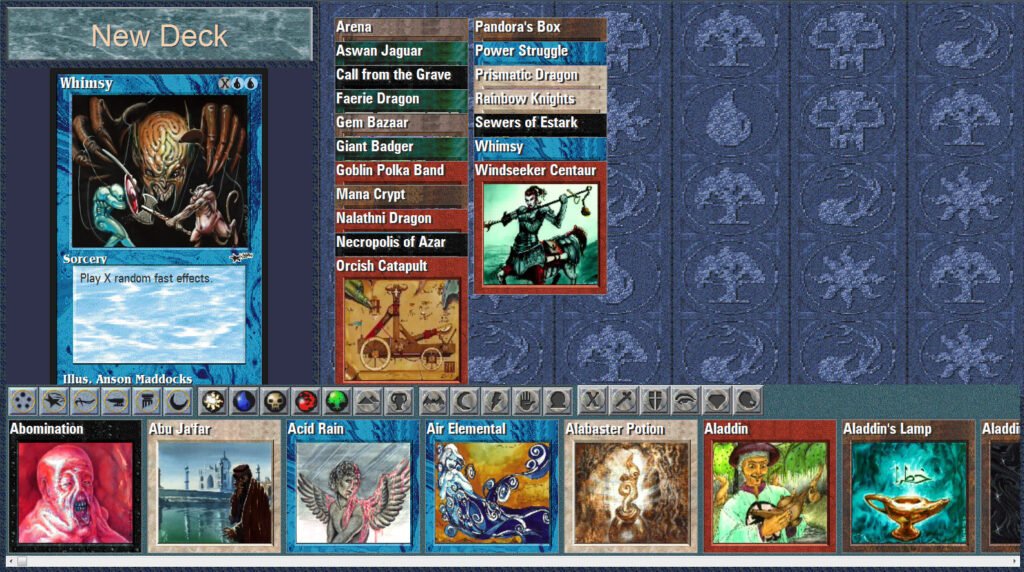
One of the coolest, most overlooked aspects of the MicroProse game was the “Astral” set. These were cards designed specifically for the PC game that utilized mechanics impossible to track in a physical card game. For example, a card might have an effect that targeted a random creature in play or a random card in your deck. This was years before Hearthstone would lean heavily into “RNG” mechanics. MicroProse was experimenting with the digital medium in ways that were far ahead of their time, proving that Magic didn’t have to be a 1:1 port of the paper game to be successful. It could be something more: a living, breathing digital ecosystem.
However, the game wasn’t without its flaws. It was notorious for crashing, and as the “Manalink” expansion added more cards, the engine began to groan under the weight of its own complexity. Despite this, a dedicated community of modders has kept the game alive for over twenty-five years. They have updated the card pool to include modern sets, fixed the bugs, and ensured that Shandalar remains playable on modern versions of Windows. This level of devotion speaks to the fundamental strength of the 1997 design.
Why It Still Matters Today
In the current landscape of gaming, where everything is polished, monetized, and connected to a server, the 1997 Magic: The Gathering feels like a relic from a more adventurous age. It didn’t want your credit card for “gems” or “packs”; it just wanted you to explore its weird, dangerous world. It captured the “kitchen table” feel of Magic—the sense of discovery when you find a weird combo or finally defeat a boss that has been terrorizing you for hours.
If you can find a way to run it, Shandalar is still worth your time. It’s a reminder that card games are about more than just optimal win rates and climbing a ladder. They are about the stories we tell within the game, the narrow escapes, and the feeling of growing from a novice with a handful of goblins into a master wizard capable of warping reality itself. MicroProse didn’t just make a game; they captured lightning in a bottle, and that lightning is still flickering in the code of 1997.