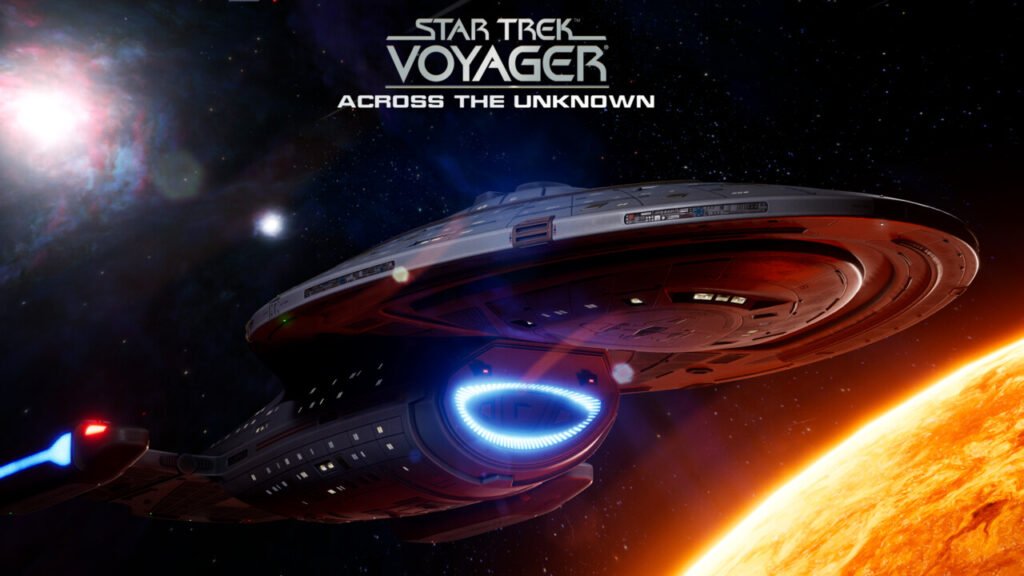

You probably all know that the U.S.S. Voyager holds a special, slightly chaotic place in every Trekkie`s heart. It’s the show about a ship stranded 70,000 light-years from home, surviving on coffee, hope, and a whole lot of “will-they-won’t-they” between Janeway and Chakotay. For years, we’ve wanted a game that truly captured the desperation of being lost in the Delta Quadrant. Well, fire up the replicators, because Gamexcite and Daedalic Entertainment just dropped Star Trek: Voyager – Across the Unknown.
A New Way to Experience the Delta Quadrant
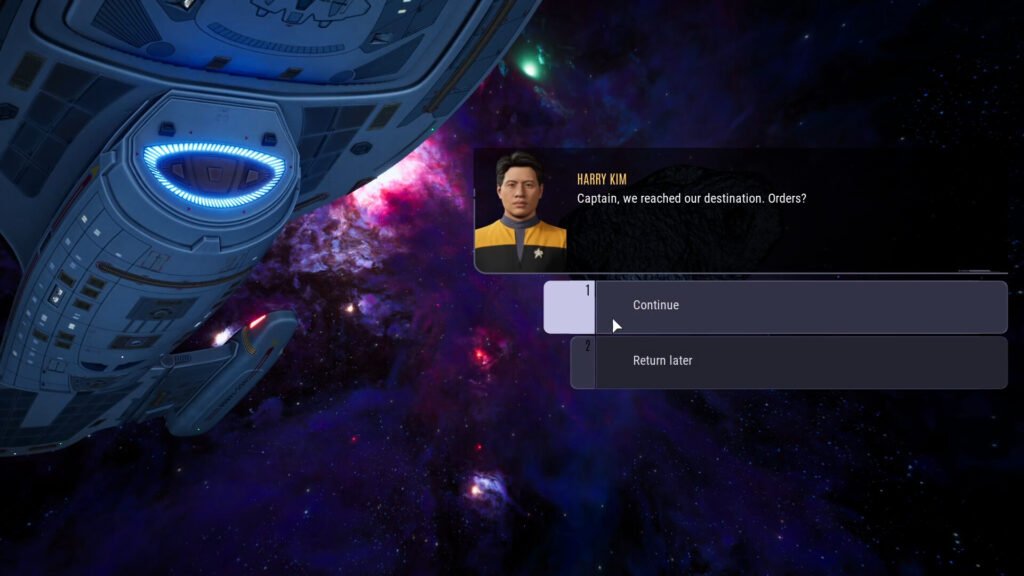
The game kicks off exactly where you’d expect: with the Caretaker’s massive energy wave snatching Voyager out of the Badlands and yeeting it across the galaxy. But here is the twist that makes this game stand out from every other Trek title: it’s a narrative adventure with roguelite elements. This means that while the major milestones of the show are there, the journey itself is never the same twice. You aren’t just watching Captain Kathryn Janeway make the tough calls; you are the Captain, and your decisions actually matter.
From the moment you hit that first sector, the game challenges you with the ultimate “What If?” scenarios. What if Janeway had used the Caretaker’s array to go home immediately? The game actually lets you do it—and the credits roll in five minutes. It’s a hilarious nod to the fans, but it also sets the stage for the real meat of the game: navigating 12 massive sectors of space where every alliance and every blown-up Kazon ship has long-term consequences.
Rebuilding a Legend from the Inside Out
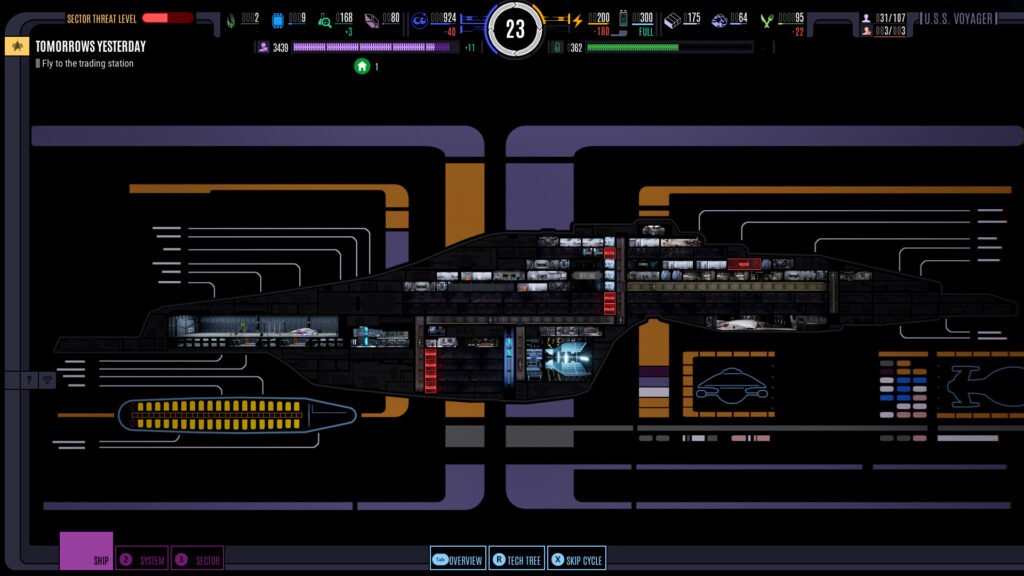
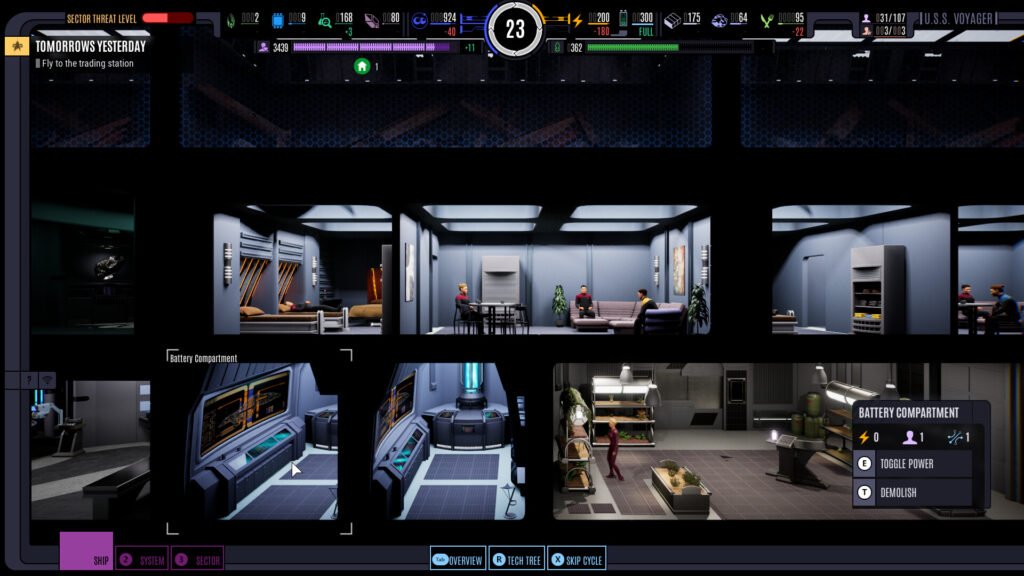
One of the most satisfying parts of Across the Unknown is the ship management system. If you’ve played games like XCOM or Fallout Shelter, you’ll recognize the “cutaway” view of the ship. When Voyager arrives in the Delta Quadrant, she is a mess. Systems are failing, decks are decompressed, and the warp core is held together by prayers and Neelix’s leftovers. You have to assign engineering teams to clear wreckage, repair life support, and build new facilities like bio-labs or research stations.
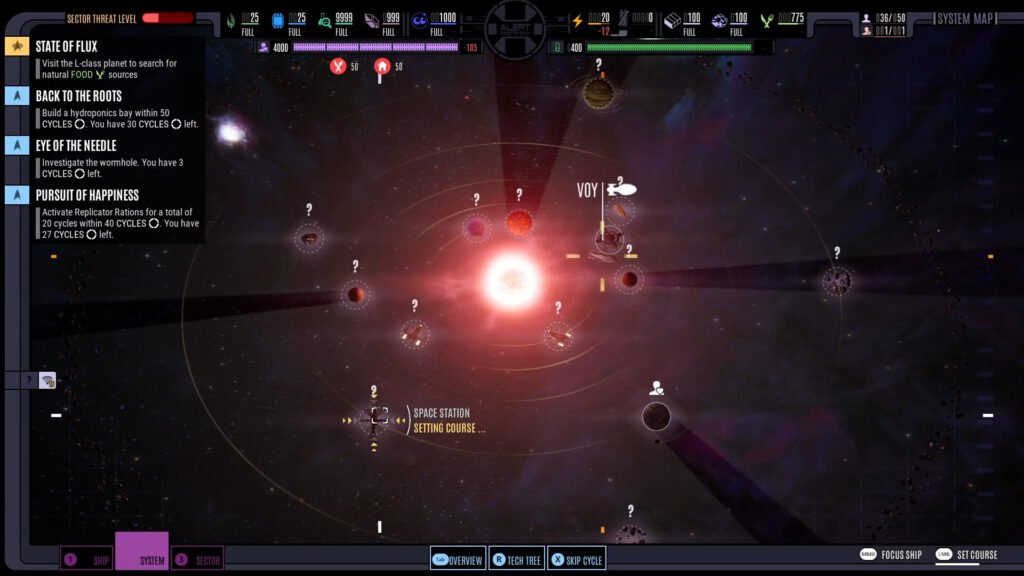
Resource management is brutal but fair. You’re tracking over a dozen different variables, from dilithium and titanium to the crew’s morale and oxygen levels. It really drives home the “survival” aspect of the show. You can’t just stop at a Starbase to refuel; you have to scan asteroid belts and bargain with sketchy Ferengi traders just to keep the lights on. If you don’t build enough crew quarters, morale plummets. If you ignore the hull damage for too long, a single combat encounter could be your last. It’s a stressful, wonderful balancing act that makes you appreciate why Janeway was always so grumpy before her first cup of coffee.
Tactical Bridge Combat and Away Missions
When the talking stops and the phasers come out, the game switches to a tactical combat mode. This isn’t a twitchy dogfighting sim; it’s a real-time with pause strategy system that feels like you’re actually sitting in the Captain’s chair. You don’t fly the ship directly. Instead, you issue commands to your officers. You target specific enemy systems—maybe you want to disable a Borg Cube’s tractor beam or knock out a Hirogen hunter’s engines.
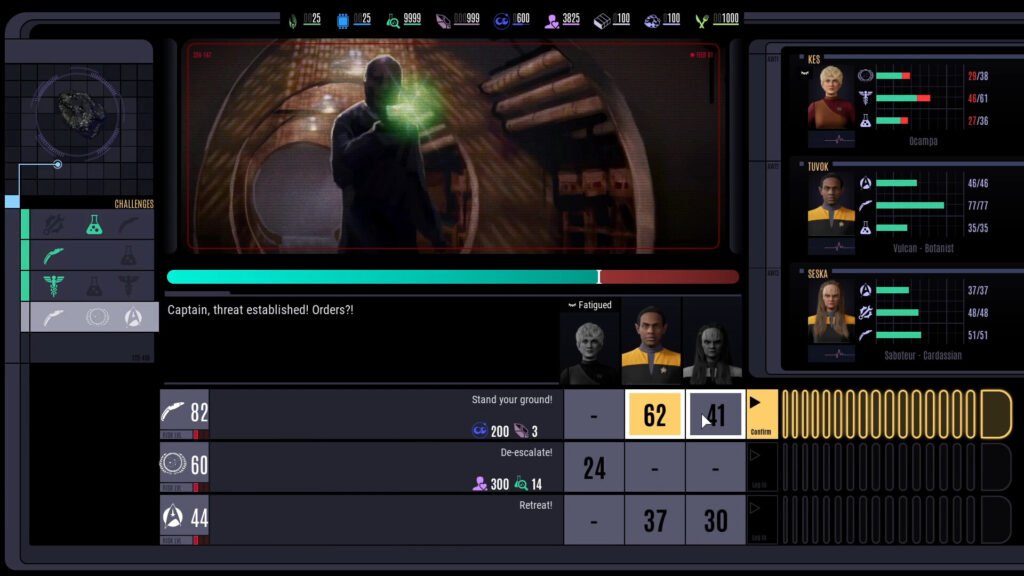
The individual skills of your crew are everything here. Having Tuvok at tactical gives you better targeting, while B’Elanna Torres in engineering can squeeze extra power out of the shields when things get hairy. This synergy extends to the away missions, which play out like narrative RPG segments. You pick a team based on their stats—Diplomacy, Science, Security, or Medical—and navigate through text-based events with skill checks. Be careful, though: the game features permadeath for your crew. If you send Harry Kim on a dangerous mission and he doesn’t make it, he is gone for good in that run. It adds a layer of weight to every decision that the TV show simply couldn’t replicate.
Changing the Course of History
The absolute highlight for any hardcore Trekkie is the ability to rewrite the most controversial moments of the series. The developers clearly knew their audience, because they included the infamous Tuvix dilemma. In the show, Janeway’s choice to separate Tuvix back into Tuvok and Neelix divided the fandom for decades. In the game, you get to make that choice yourself. Do you keep the new, combined lifeform? Do you follow the original timeline? Or do you find a technobabble third option using Borg nanites you scavenged earlier?
These branching paths are everywhere. You can choose to integrate Borg technology into the ship’s systems, giving you a massive power boost at the cost of your crew’s humanity and a higher risk of detection. You can even change the fate of characters like Seska or Kes. Because the game is built with Unreal Engine 5, these moments are punctuated by atmospheric lighting and detailed character models that make the iconic bridge feel alive. Hearing the original voices of Robert Duncan McNeill as Tom Paris and Tim Russ as Tuvok during the sector logs is the icing on the cake.
The Realities of a Modern Launch
Now, it’s not all smooth sailing through the wormhole. Since the game launched on February 18, 2026, there have been some reports from the community about bugs. The most common complaint is the saving system. Currently, the game relies heavily on autosaves at the start of sectors, which can be frustrating if you’re playing on a high difficulty like the Year of Hell mode and your game crashes. The developers at Gamexcite have already been active on Discord, promising a patch that will introduce a more flexible save system soon.
Performance-wise, the game is a bit of a beast. You’ll want a solid rig or a PlayStation 5 / Xbox Series X to see those Unreal Engine 5 textures at their best. It’s also one of the first big titles for the Nintendo Switch 2, and while it runs impressively well there, it definitely takes a hit in the resolution department compared to the PC version. Still, being able to manage a starship from your couch is a dream come true for many of us.
Final Thoughts from the Bridge
Star Trek: Voyager – Across the Unknown is exactly what the franchise needed: a game that respects the source material but isn’t afraid to let players break it. It captures the spirit of the 90s era while utilizing modern roguelite mechanics to keep the gameplay fresh for multiple runs. Whether you’re a casual fan who just wants to see the crew again or a hardcore strategist who wants to turn Voyager into a Borg-hybrid juggernaut, there is something here for you. Just remember: there’s coffee in that nebula, and it’s your job to go get it.