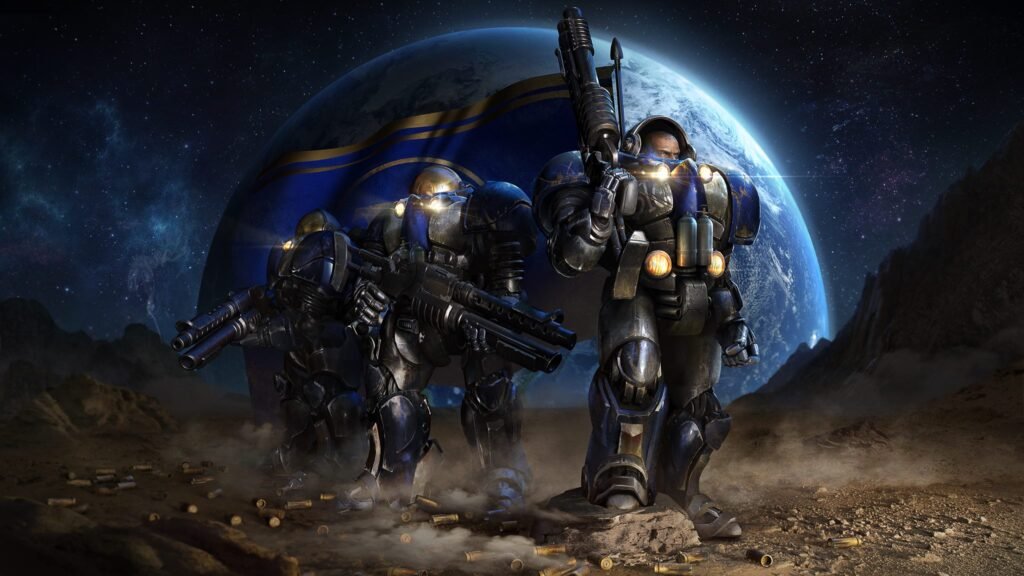

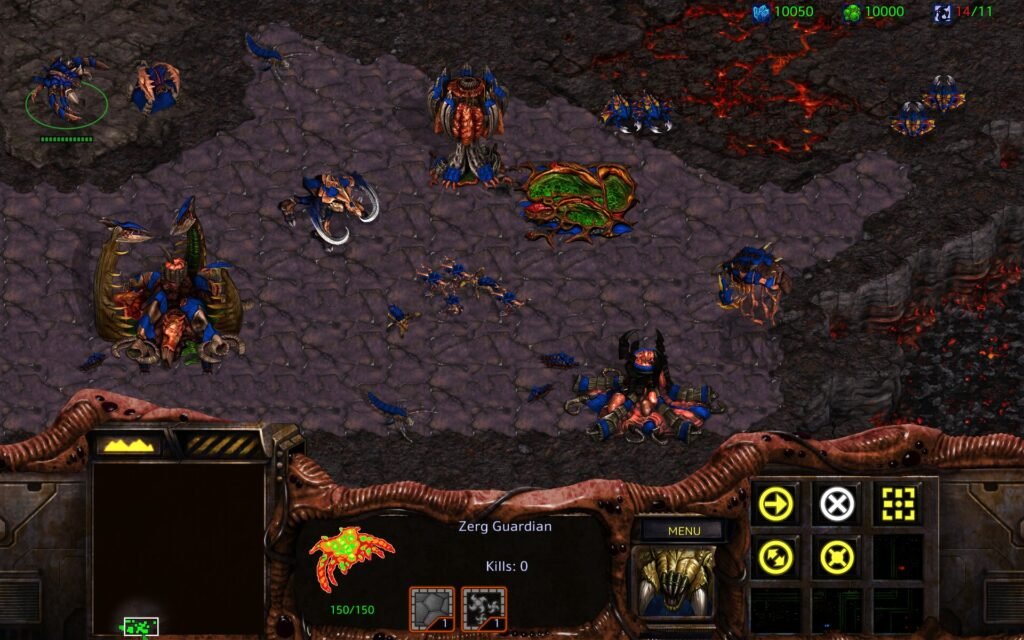
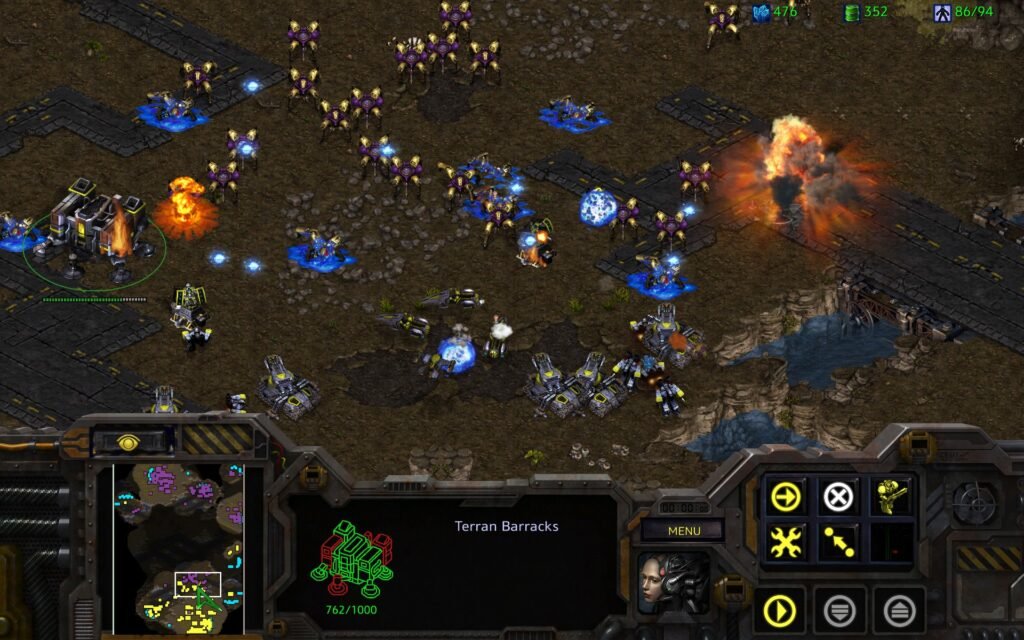
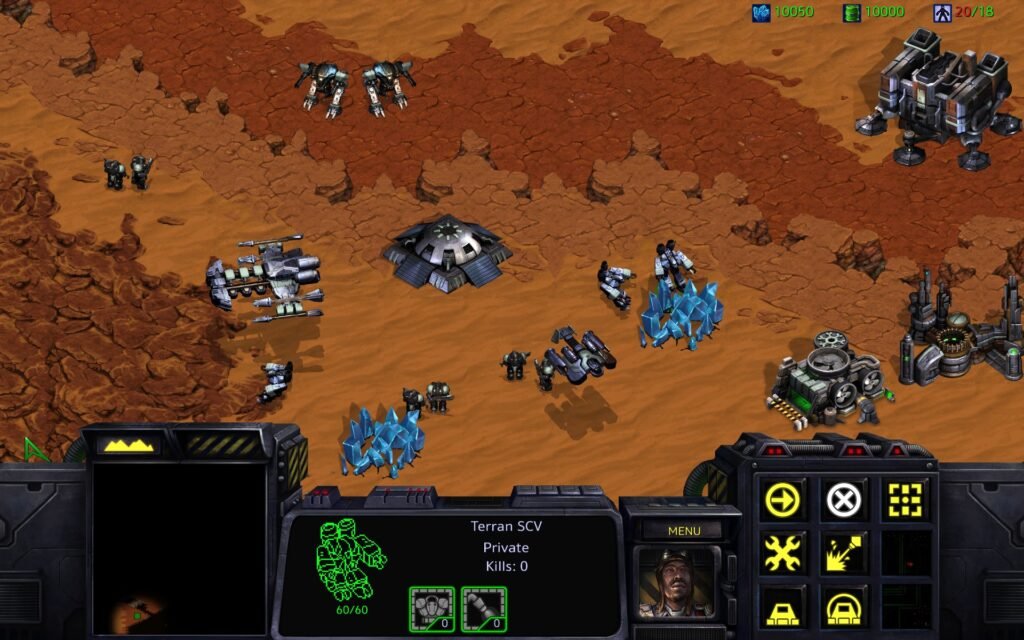
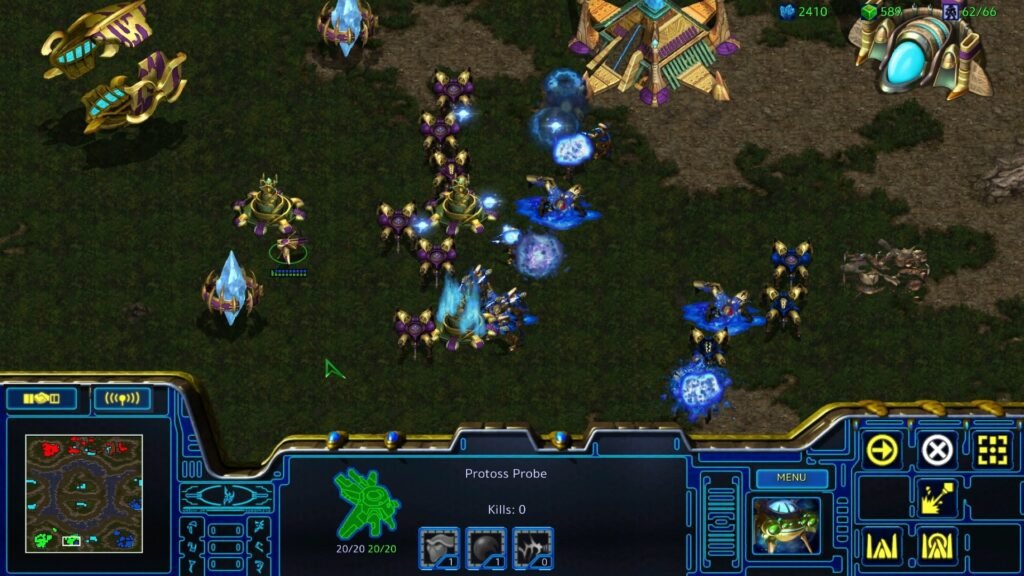
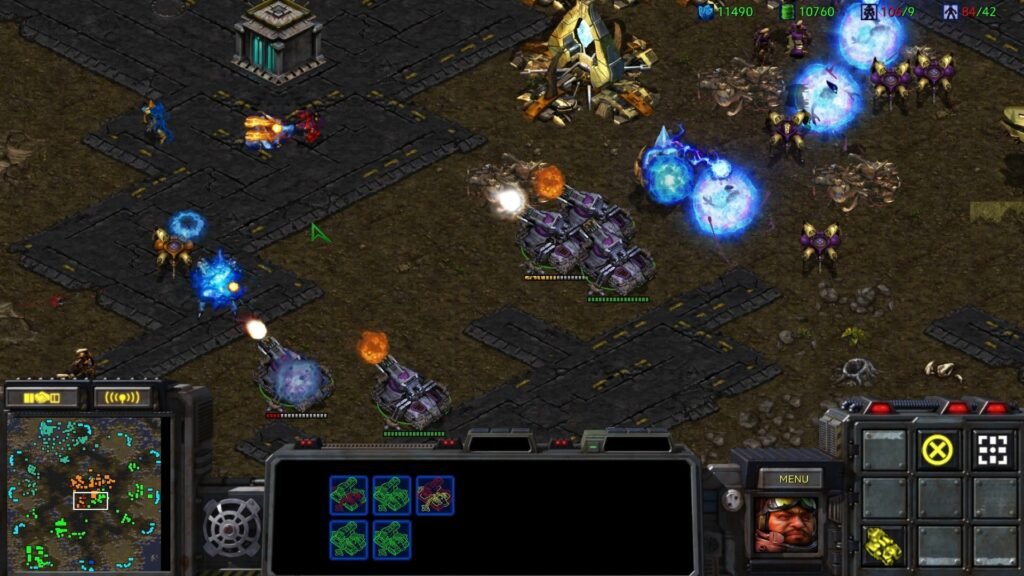
StarCraft dropped in 1998 and somehow still feels like the blueprint for what a real-time strategy game should be. Blizzard took the lessons from Warcraft II, threw out the orcs-and-humans template, and built something that was asymmetric, tense, and packed with personality. Three races that actually played differently. Not just reskins with different unit names. The Terrans felt like scrappy humans with tanks, bunkers, and the ability to lift their buildings and run. The Zerg were pure biological horror, swarming and mutating. The Protoss were the high-tech teleporters with shields and that satisfying whoosh of a fully charged psi storm. It was the first time an RTS really made you change how you thought depending on which side you picked.
The campaign sold the whole package. You started as a Confederate marshal named Jim Raynor, watched the Confederacy fall apart, got tangled up with the Sons of Korhal, and then everything went sideways when the Zerg showed up and turned Sarah Kerrigan into the Queen of Blades. The story had actual stakes and memorable characters. The voice acting was over the top in the best way. Tassadar’s calm resignation, Kerrigan’s slow transformation, the Overmind’s booming presence. Blizzard’s early cinematic department was flexing hard, and those cutscenes still hold up as pure 90s sci-fi cheese done right.
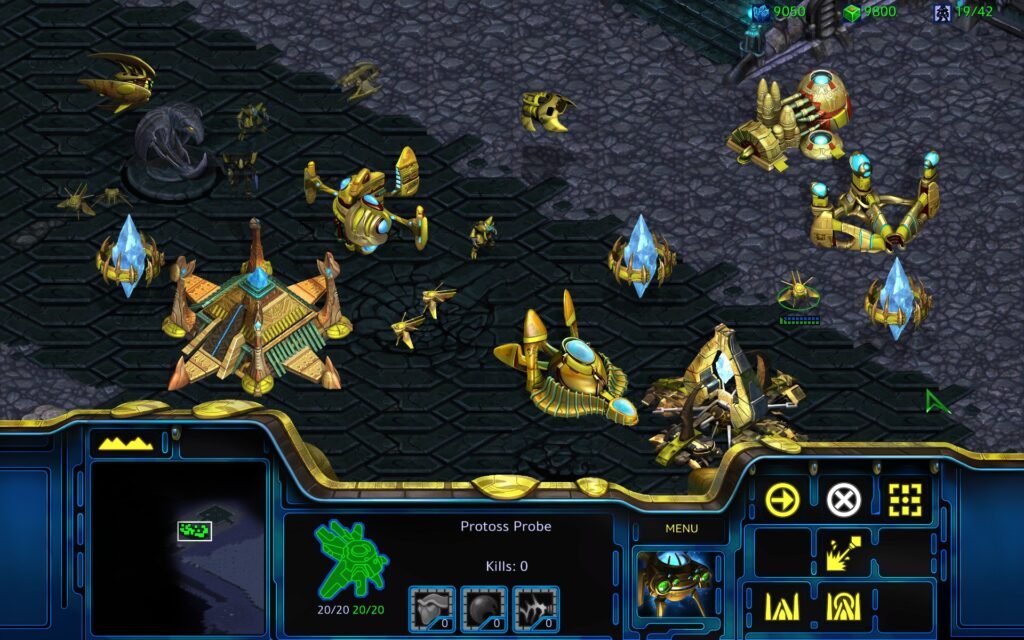
Multiplayer was where the game became immortal. Battle.net made online play accessible at a time when most people were still figuring out dial-up. The ladder, the custom maps, the endless theorycrafting about build orders. It was simple to pick up and nearly impossible to truly master. The skill ceiling was ridiculous. Micro, macro, timing attacks, map control. Every match felt like a high-stakes chess game played at double speed with explosions. South Korea took the game and turned it into a national obsession. Professional leagues, TV broadcasts, celebrity players with fan clubs bigger than most rock bands. StarCraft basically invented the modern esports template before anyone was using the word “esports.”
Sales numbers were absurd for the time. Over a million and a half copies in the first year alone, eventually climbing past nine or ten million when you factor in the expansion. It was the best-selling PC game of 1998 and stayed relevant for years. The balance was never perfect, but it was close enough that the competitive scene could thrive for over a decade on the same core ruleset.
Then came the expansions, and this is where things get interesting because not all of them were created equal.
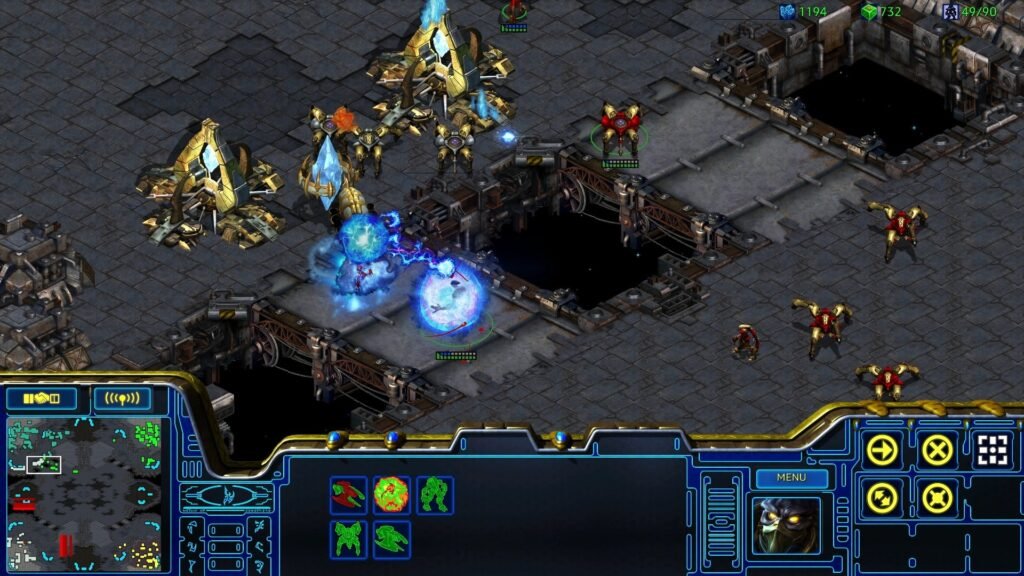
Brood War arrived in December 1998, less than nine months after the base game, and it is the reason most people still talk about the original StarCraft today. Blizzard basically treated it like a full sequel. Three new campaigns that continued the story right after the original ending. New units that fixed a lot of the original balance issues and added fresh tactics. Medics for the Terrans that completely changed how bio armies worked. Dark Templar and Corsairs for the Protoss. Lurkers and Devourers for the Zerg. The map pool expanded. The AI got smarter. The single-player missions got meaner and more creative.
The story in Brood War is darker and more complex. The United Earth Directorate shows up from Earth itself, bringing a whole new level of bureaucracy and force. Kerrigan’s rise to full power is handled with real menace. Alliances form and shatter. Characters die in ways that actually sting. By the end you understand why people still argue about whether the Queen of Blades is a tragic figure or an absolute monster. Competitive play shifted permanently once Brood War hit. The meta that defined the Korean professional scene for more than ten years was pure Brood War. When people say “StarCraft” in an esports context, they almost always mean the expansion. The base game without it feels incomplete now.
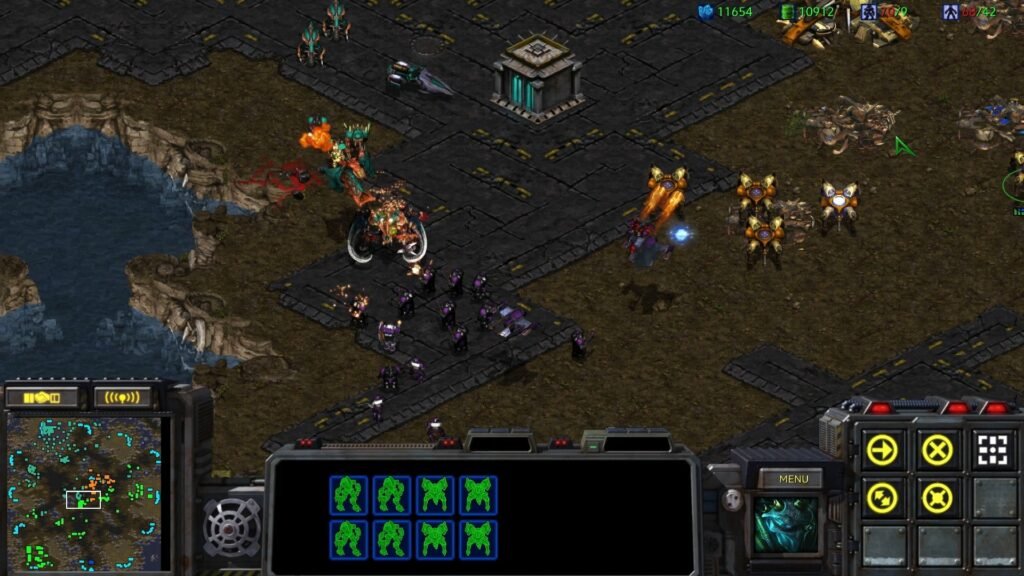
Not every expansion got the same love. Insurrection came out in July 1998, developed by Aztech New Media and officially licensed by Blizzard. It drops you onto the planet Brontes IV during the original Terran campaign timeline. Three full campaigns, one for each race, totaling around thirty missions. There are new hero units with unique abilities, a ton of multiplayer maps, and a story about local insurgency, cultists who worship the Zerg, and Protoss forces trying to clean house. The tone is pure B-movie. Some of the voice acting is gloriously wooden. Map design is uneven and a few triggers are buggy even after patches. It never reached the polish of the main game, and critics were mixed at best. Still, there is a weird charm to it. Playing through the chaos of Brontes IV feels like a side story that the main campaign only hinted at. For completionists and people who just wanted more StarCraft missions in 1998, it scratched an itch. It just never became essential the way Brood War did.
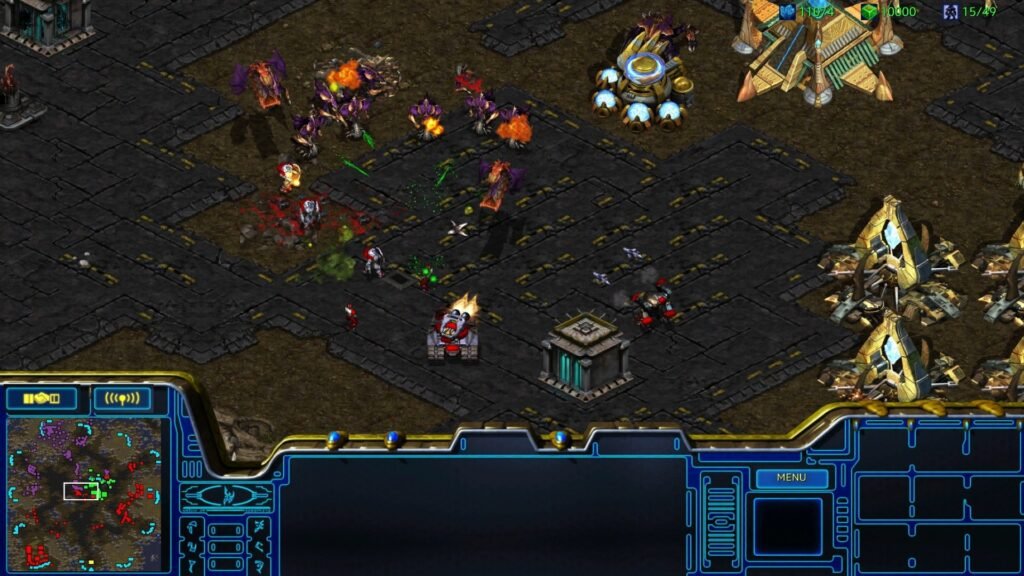
Retribution followed a similar path. Developed by Stardock, published by WizardWorks, and also authorized by Blizzard, it released later in 1998. The plot centers on the Argus Stone, an ancient Xel’Naga artifact on the Dominion world of Aridas. All three races converge to claim it because whoever controls the stone supposedly controls the universe. You get campaigns for Protoss, Terran, and Zerg, new hero units with custom voice work, more multiplayer maps, and some new music and sound effects. The campaigns sit somewhere between the original game’s Episode II and the rise of the Overmind. It is more polished than Insurrection in places, but the missions can feel repetitive and the overall quality still sits well below Blizzard’s own work. Reviews were lukewarm. Both of these third-party expansions are footnotes now. Fun curiosities if you can get them running on modern systems, but they never reshaped the game the way Brood War did. Most players who care about the lore treat them as soft canon at best.
Then there is the one that got away. StarCraft: Ghost. Announced in 2002, developed first by Nihilistic Software, it was supposed to be a third-person stealth-action game starring a Terran Ghost operative named Nova. The idea was to put players on the ground in the StarCraft universe instead of looking down from orbit. Cloaking, psionic powers, calling down nukes, sneaking through Zerg-infested facilities or Dominion bases. It was aimed at consoles, specifically the original Xbox, PlayStation 2, and GameCube. Early footage looked promising. The art direction felt right. Nova herself became a fan-favorite character even though the game never shipped.
Development turned into a slow-motion train wreck. Nihilistic spent years iterating while Blizzard kept changing direction. Was it a pure stealth game or a more action-oriented shooter? Should multiplayer be the focus? Feature creep set in. The team was chasing whatever was popular at the moment. By 2004 the game was playable but incomplete, and the relationship between Nihilistic and Blizzard had soured. Development moved to Swingin’ Ape Studios. Blizzard later bought Swingin’ Ape. The GameCube version was cancelled. Release dates kept slipping. In 2006 Blizzard put the project on indefinite hold, citing the jump to next-generation consoles and the desire to maintain quality. Official cancellation only came years later, in 2014. Builds eventually leaked, and you can see what might have been. It is one of gaming’s classic vaporware stories. A game that spent half a decade in development hell and still managed to influence the franchise. Nova made it into StarCraft II and got her own mission pack. The concept of a Ghost-focused story never completely died.
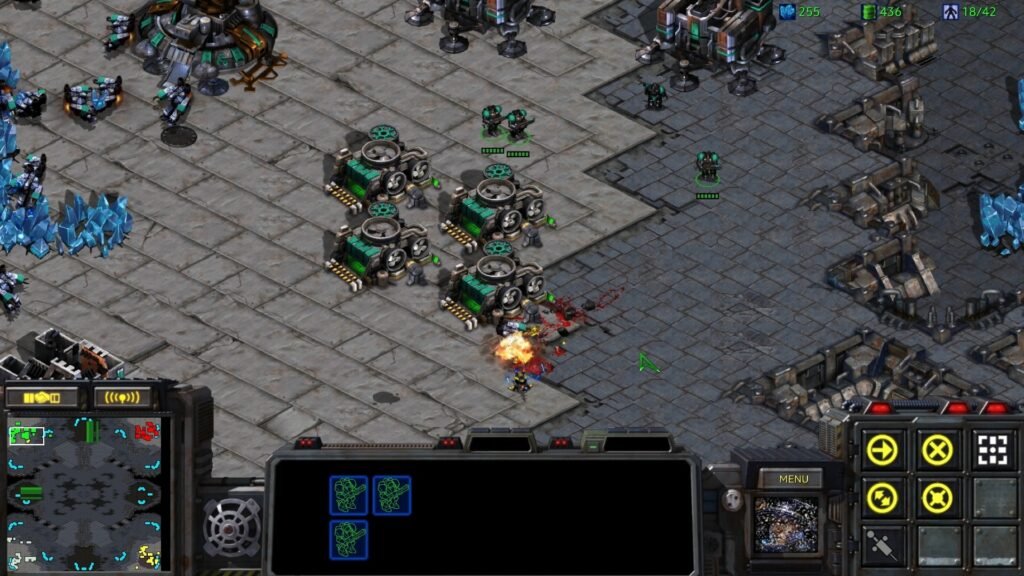
Looking back, the original StarCraft and Brood War feel like the peak of a certain kind of design philosophy. No modern quality-of-life features. No automatic worker production. Pathfinding that could be janky. An interface that demanded constant attention. Yet that friction is part of why the game still has a dedicated scene. The pure skill expression is unmatched. Modern RTS games have smoother controls and prettier graphics, but very few have the same combination of deep strategy, memorable factions, and pure competitive purity.
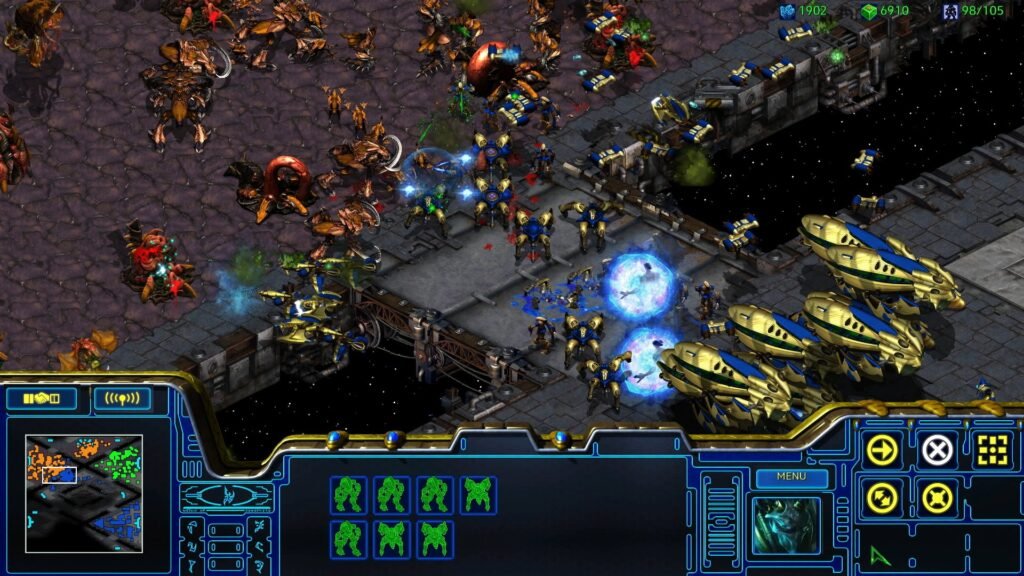
StarCraft Remastered launched in August 2017 and gave the classic game the respectful glow-up it deserved. Blizzard’s classic games team rebuilt the visuals in crisp 4K while keeping every single frame of gameplay and balance exactly as it was in 1998. You can toggle between the shiny new high-definition sprites and the original pixel art with a single keypress, which is pure nostalgia fuel. The audio got a full re-recording, the campaigns received new comic-style mission briefings, and modern features like cloud saves, improved matchmaking, leaderboards, and cross-play with the free original version made it feel current without changing the soul of the game. Around the same time Blizzard made the base StarCraft and Brood War completely free, so Remastered became the polished way for both veterans and newcomers to experience the complete original package on modern hardware. It proved the old formula still worked, and the competitive scene happily kept grinding on the same ruleset that had defined esports for nearly twenty years.
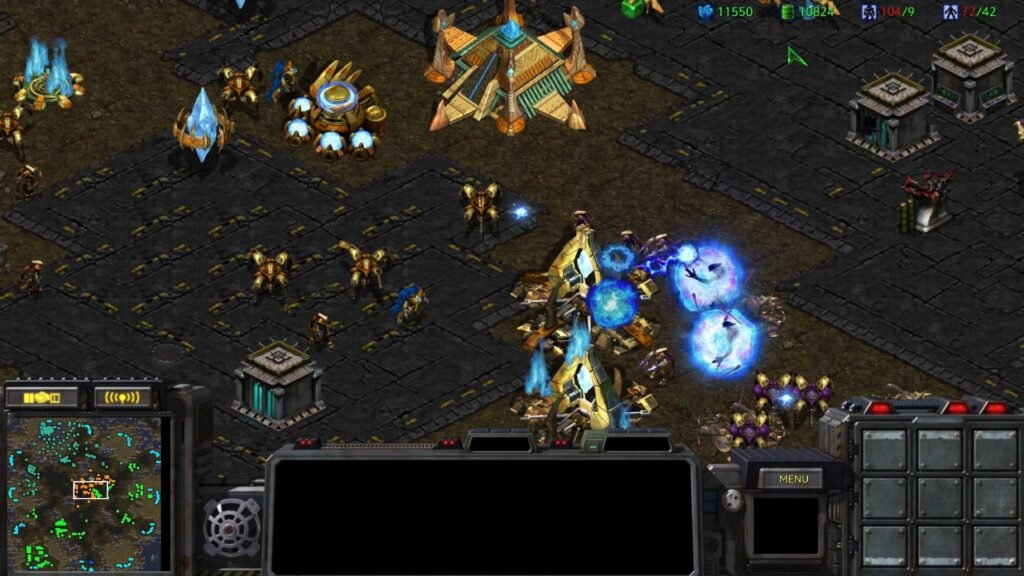
Not long after, the fan community delivered its own love letter in the form of Mass Recall, a total conversion mod for StarCraft II. A dedicated team of modders spent years painstakingly recreating every mission from the original game, Brood War, the demo campaigns, and even some cut content inside the StarCraft II engine. The result is the full classic single-player experience running with modern pathfinding, smoother controls, higher-resolution models (including optional retro looks), remastered cutscenes, and difficulty options that go beyond the original’s already punishing curve. Because StarCraft II is free-to-play, Mass Recall effectively gives anyone the complete original campaigns for nothing more than a download. Optional extras like the ability to use Brood War units in the base-game missions and the expanded Enslavers Redux campaign turn it into more than just a port. It is a living, evolving tribute that keeps the old stories playable for a new generation while showing just how much passion the StarCraft community still pours into keeping the legacy alive.
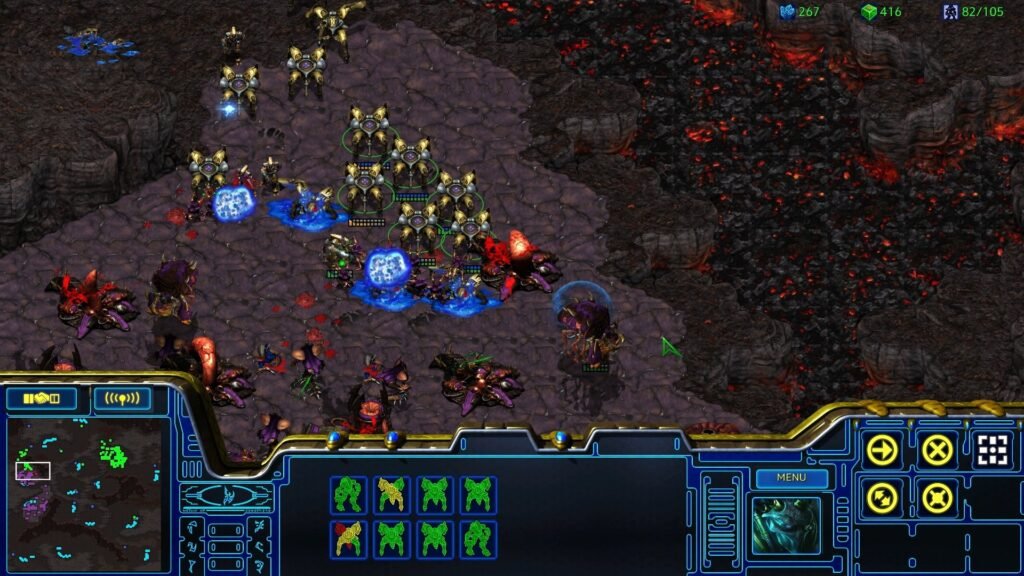
The legacy of Starcraft is not just the sales numbers or the tournaments. It is the way the game made people fall in love with strategy itself. The late nights spent refining a build order. The pure adrenaline of a perfectly timed drop. The stories that still get told about legendary matches from the Korean leagues. Blizzard went on to make bigger and flashier games, but they never quite recaptured the raw, focused intensity of that first StarCraft and its essential expansion. Everything that came after, including the sequels, stands on the shoulders of what they built in those frantic years at the end of the 1990s. And somehow, more than a quarter century later, people are still saying “gg” and meaning it.