
Just when you think the superhero genre has completely run out of fresh webs to spin, a project arrives that completely tears up the standard playbook and burns the pieces in a trash fire down a rainy New York alleyway. Enter the spectacular first season of Spider-Noir, the live-action streaming series spinning exclusively onto Prime Video and MGM+. This is not your friendly neighborhood teenager dealing with high school drama and multiverse fatigue. Instead, this series takes a magnificent, deeply atmospheric dive into a standalone, Prohibition-era playground where comic book bombast smashes directly into the gritty, smoke-filled world of classic Hollywood crime dramas. It is bold, incredibly stylish, and easily the most distinct piece of Marvel-adjacent television to hit the small screen in an age.
The absolute secret weapon anchoring this entire eccentric experiment is the incomparable Nicolas Cage, who finally gets to portray the character in the flesh after voicing an animated variant years ago. Cage steps into the scuffed wingtips of Ben Reilly, a grizzled, cynical, down-on-his-luck private investigator operating in an alternate 1930s Manhattan. This version of Reilly is a deeply wounded man who actually hung up his superhero mantle as The Spider five years prior after a devastating personal tragedy involving the woman he loved. When we meet him, he is drowning his inner demons in cheap booze, struggling to pay his bills, and treating his supernatural gifts as a curse rather than a calling. Cage plays the character with a brilliant, highly specific acting style that feels seventy percent Humphrey Bogart and thirty percent Bugs Bunny, leaping effortlessly from moments of tragic, quiet melodrama to explosive, manic physical comedy.
The narrative catalyst that forces Ben out of retirement is the sudden, terrifying emergence of a new breed of criminals possessing impossible, science-fiction abilities. Up until this point, the gritty streets of the Big Apple had only ever known one super-powered vigilante, but suddenly, the criminal underworld is being upended by a wave of freakish rogues. This rogue’s gallery features wonderfully grounded, period-accurate reimagining of classic villains. We get Jack Huston as a deeply tragic, physically imposing take on Sandman (Flint Marko) and Abraham Popoola as a menacing, cold-blooded version of the notorious mob enforcer Tombstone (Lonnie Lincoln). Watching a hard-boiled detective try to solve a traditional noir mystery while simultaneously uncovering a sci-fi conspiracy involving glowing, super-powered gangsters creates an incredibly addictive hook that keeps the pacing tight across all eight episodes.
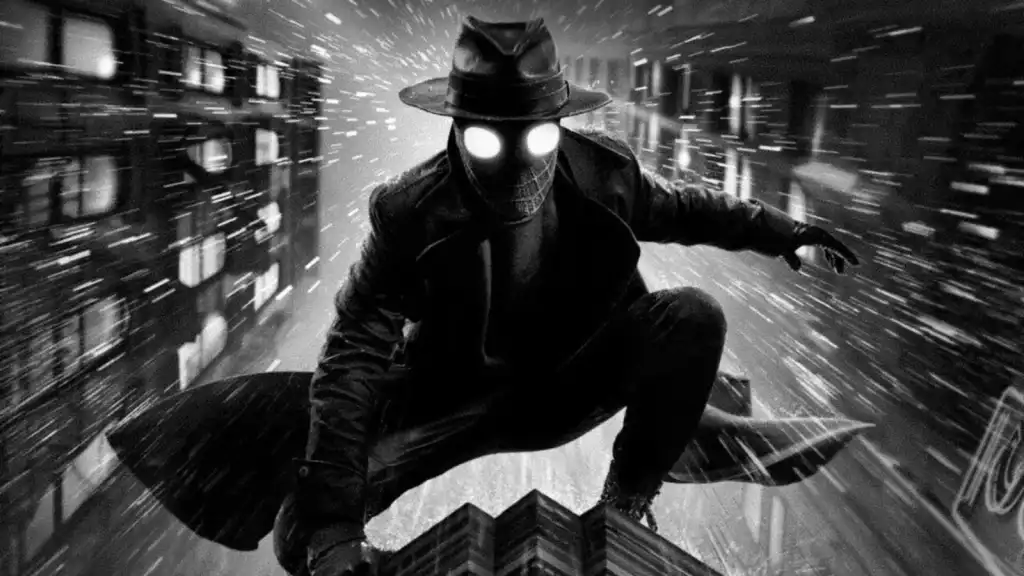
What makes the show stand head and shoulders above its streaming peers is the sheer aesthetic commitment of the showrunners, Oren Uziel and Steve Lightfoot. In a stroke of absolute genius, the series was engineered to be viewed in two distinct formats: a vibrant True-Hue Color version that emphasizes the lush, period-accurate costume designs, and an Authentic Black and White format. Do yourself a massive favor and opt for the monochrome presentation on your first watch. The cinematography is an absolute visual triumph, utilizing stark chiaroscuro lighting to cast massive, dramatic shadows across rain-slicked cobblestones, dingy office window blinds, and smoky jazz clubs. Every single frame looks like a gorgeous, high-budget love letter to vintage studio-era cinema, making the supernatural web-slinging feel grounded in a tangible, historical reality.
The incredible ensemble cast surrounding Cage ensures that the series never devolves into a one-man novelty show. Lamorne Morris is an absolute delight as the dogged, quick-witted freelance reporter Robbie Robertson, who serves as Ben’s close friend, occasional investigative partner, and the moral compass of the entire story. Their natural, bantering chemistry provides a lot of the show’s humor and heart, especially as Robbie investigates a dark conspiracy involving World War I prisoners of war that serves as a brilliant allegorical backbone for the season. Meanwhile, Karen Rodriguez acts as the show’s secret weapon in the role of Janet Ruiz, Ben’s fiercely loyal, sharp-tongued assistant who spends most of her time demanding her back-pay and keeping the brooding detective grounded in reality.
Of course, no true crime thriller is complete without a dangerous criminal underworld, and the series delivers in spades on that front. The legendary Brendan Gleeson brings immense, terrifying gravity to the screen as the ruthless Irish mob boss Silvermane, elevating what could have been a standard gangster caricature into a deeply formidable antagonist. He is flanked by the captivating Li Jun Li as the sultry jazz singer Cat Hardy, who steps effortlessly into the quintessential femme fatale archetype, dragging Ben deeper into a web of betrayal, moral ambiguity, and shifting alliances where nobody can be completely trusted.
The action sequences are directed with a refreshing focus on physical fisticuffs, creative environment traversal, and high-flying tension rather than world-ending digital spectacles. Because Ben’s powers are constantly hindered by traumatic, blinding Spidey-sense migraines, the fights feel incredibly desperate, dangerous, and personal. When the show does lean into the surreal—such as the showstopping, hallucinatory sixth episode titled Nightmare on a Gurney—it ventures into brilliant psychological body horror that goes deeper into the protagonist’s fractured psyche than almost any other adaptation in the history of the franchise. It is a bold, creatively fertile ride that proves the superhero genre still has plenty of room for artistic reinvention when placed in the hands of creators who care deeply about style, atmosphere, and character.