
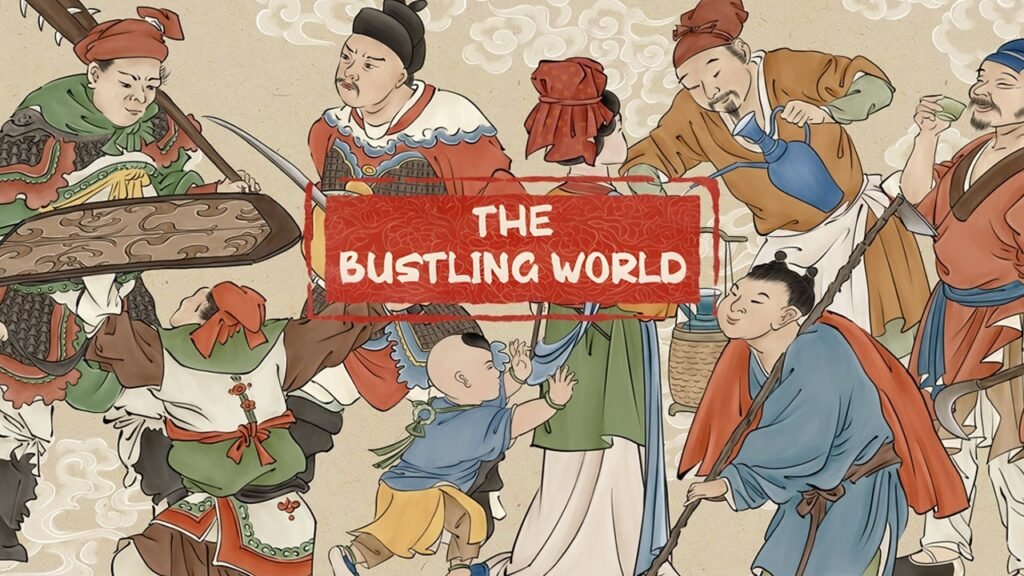

In the vast, ever-expanding landscape of open-world RPGs, few titles have managed to spark as much excitement and anticipation as The Bustling World. Developed by the indie studio FireWo Games and published by Lightning Games, this ambitious project isn’t just a game—it’s a living, breathing hand-painted scroll brought to life. Set in a fictionalized ancient China, it promises a level of freedom that borders on the impossible, blending city-building, life simulation, grand strategy, and martial arts into a single, cohesive ecosystem.
Here is why The Bustling World is being hailed as one of the most unique—and daring—gaming experiments of the decade.
A World Without Borders: The Philosophy of Freedom
At the heart of The Bustling World lies a radical design philosophy: no mandatory main quest. While most RPGs shepherd players from point A to point B through a scripted narrative, FireWo Games has opted for a sandbox where the story is emergent.
You begin as a nameless “everyperson” in a world that doesn’t wait for you to act. From there, the path is entirely yours to forge. Want to live a quiet life as a farmer, tending to over 60 varieties of authentic ancient crops? You can. Want to navigate the treacherous waters of the “Jianghu” (the martial arts underworld), joining secret sects and mastering forbidden techniques? That is also an option. For the truly ambitious, the game scales up to a grand strategy level, allowing you to establish your own regime, manage city policies, and lead armies to unify the land.

The Spiritual Successor to The Guild
For veteran strategy fans, the core loop of The Bustling World evokes strong comparisons to the cult-classic The Guild series. Much like The Guild, this title places a heavy emphasis on the interplay between family lineage, economic dominance, and political maneuvering. However, while The Guild often focused on the claustrophobic streets of medieval European cities, The Bustling World expands that DNA into a massive, seamless open world. It takes the “dynasty simulation” elements—marrying, raising heirs, and sabotaging rival families—and marries them to modern RPG mechanics. Where The Guild felt like a complex board game come to life, The Bustling World feels like a physical place where your social standing is reflected in the way NPCs bow to you on the street or the way the local economy shifts based on your production lines.
The Beauty of the Hand-Painted Brush
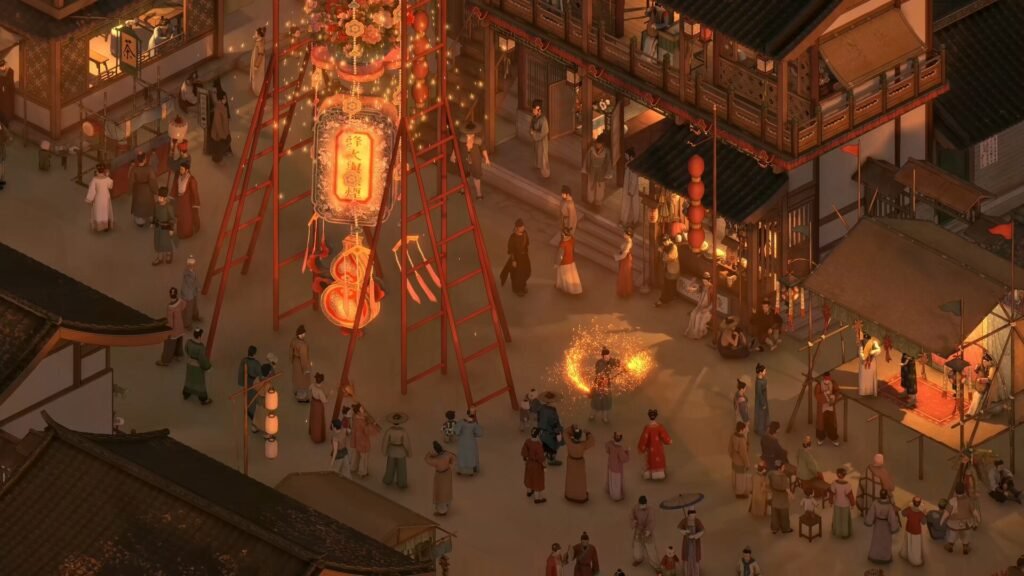
Visually, the game is a masterpiece of art direction. Eschewing the hyper-realistic 3D graphics common in modern AAA titles, The Bustling World utilizes a hand-painted aesthetic inspired by classical Chinese artwork. Every texture, character, and building has been rendered with meticulous detail to ensure a “human touch.”
The result is a world that feels like a museum come to life. Whether you are walking through a misty southern water town or a fortified northern border city, the attention to historical detail—from the architecture of the tea houses to the intricate patterns on silk robes—is staggering. The developers have even implemented motion-capture technology for animations to ensure that the fluid movements of daily life contrast beautifully with the static, painterly environments.
The “Bustling” Social Simulation
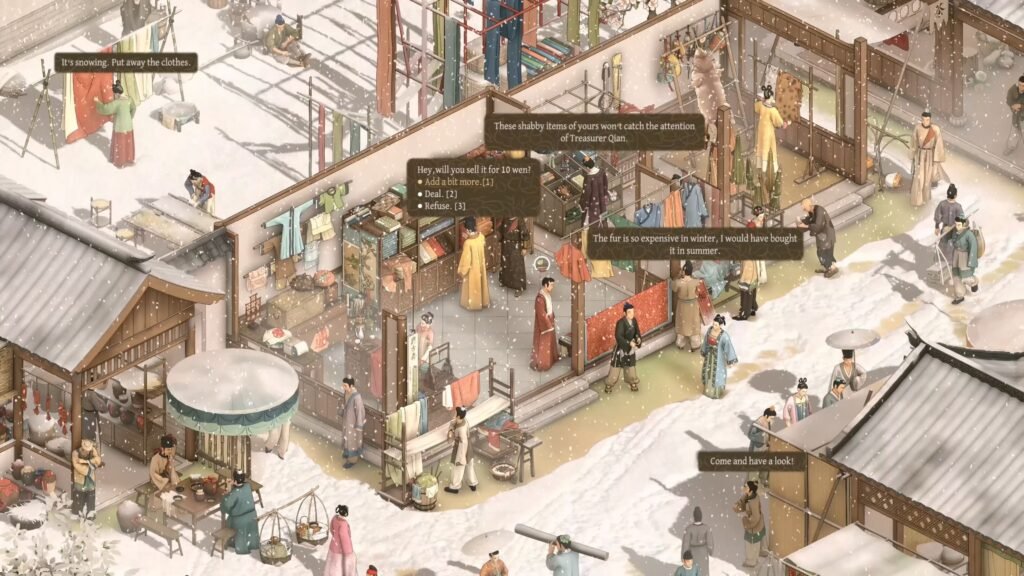
The game’s title isn’t just marketing fluff; it refers to a complex AI-driven social system. Unlike traditional NPCs that stand in one spot waiting for a dialogue prompt, the inhabitants of The Bustling World have their own lives, families, and goals.
- Dynamic Reactions: NPCs react to your actions in real-time. If you help a struggling shopkeeper, they might offer you discounts or support your political rise. If you become a notorious bandit, the community will fear you, and bounty hunters will begin to track your movements.
- The Butterfly Effect: A decision made in a small village can ripple across the entire province. Wars can break out over trade disputes, and economic booms can lead to the physical expansion of cities, with new shops and houses appearing as the population grows.
- Deep Immersion: The game features a “medicine” system where you can treat illnesses—or accidentally cause a patient’s demise. If a character dies, you can actually organize their funeral, complete with paper-money scattering and traditional burial rites, further cementing the sense of a permanent, living world.
Governance and Grand Strategy
For those who find farming or shopkeeping too small-scale, The Bustling World transforms into a sophisticated management simulator. Once you acquire enough influence or military might, you can take over a city. This opens up a suite of “4X” (Explore, Expand, Exploit, Exterminate) mechanics:
- Policy Formulation: Issue decrees regarding taxes, culture, and research to shape the growth of your territory.
- Diplomatic Finesse: Negotiate with NPC-controlled factions. Use trade, espionage, or marriage alliances to secure your borders.
- Military Might: Recruit heroes and train mercenary legions to defend against rebellions or to launch calculated assaults on rival domains.
A New Frontier for Indie Gaming
By focusing on systems rather than scripted content, FireWo Games has created a playground where the player’s imagination is the primary engine of the narrative. Recent development diaries from Lightning Games have shown significant progress, with overhauls to the user interface and refined AI logic that makes the world feel more reactive than ever.
The Bustling World represents a new wave of development that is moving away from repetitive quest markers and toward high-concept experiences. It is a game that respects the player’s intelligence, trusting them to find their own fun in a world that feels indifferent to their presence until they force it to pay attention.
Whether you’re looking to lead an empire or simply want to spend your afternoons fishing and watching the sun set over a hand-painted horizon, The Bustling World is a journey worth keeping on your radar as we head toward its launch.