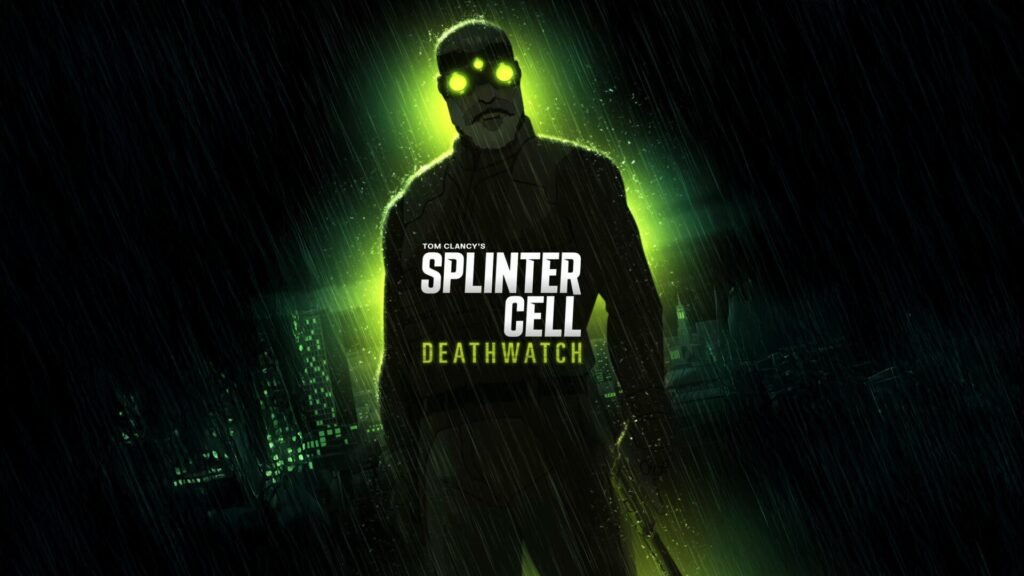

It’s been over a decade since we last saw Sam Fisher in a proper video game, and while we’re still waiting for that elusive remake, Netflix’s Splinter Cell: Deathwatch finally gives us the grizzled, cynical Sam we’ve been missing.
Produced by Derek Kolstad (the guy who gave us John Wick), this eight-episode animated run is exactly what you’d expect: dark, sleek, and surprisingly bloody. Sam’s not a young man anymore—he’s retired to a quiet farm in Poland, feeding cows and staying out of the shadows—but as the show reminds us, there are no “ex-Splinter Agents.” When a young operative named Zinnia McKenna crashes into his life with a trail of assassins behind her, Sam picks up his Five-Seven and gets back to work.
Liev Schreiber takes over the voice acting duties from the legendary Michael Ironside, and honestly? He kills it. He captures that same dry, “I’m too old for this” energy perfectly. The show balances old-school stealth with high-octane action, though it definitely leans more into the “John Wick” style of brutal combat than the games did. If you’re a fan of the franchise, you’ll love the little nods—like the iconic thwip of the trifocal goggles powering up.
The best news? Netflix didn’t wait long to pull the trigger: Splinter Cell: Deathwatch has already been renewed for Season 2! Given that cliffhanger ending, it’s a massive relief.
Episode Breakdown
Episode 1: “Up From the Grave” The series kicks off with Zinnia McKenna on a botched extraction mission in Lithuania. She finds her asset dead and goes on a revenge spree, eventually fleeing to Poland to find a retired Sam Fisher. Sam’s peaceful farm life is promptly ruined when a team of mercenaries shows up, leading to a brutal skirmish where Sam proves he hasn’t lost his touch.
Episode 2: “Dinner First, Talk Later” Sam and Zinnia head to Gdańsk to lay low, but the bad guys are using hijacked Echelon tech to track them. We get introduced to Diana Shetland, the daughter of Sam’s old friend-turned-enemy Douglas Shetland, who is now running the tech giant Displace. The tension builds as Sam realizes this isn’t just a simple hit job.
Episode 3: “Welcome to the 4th Echelon” Sam and Zinnia extract data from a literal tooth (yep, it’s that kind of show) which contains incriminating files on Displace. Meanwhile, Anna “Grim” Grímsdóttir is busy putting together a new support team, including a Canadian hacker named Thunder, officially bringing 4th Echelon back into the game.
Episode 4: “The Shetland Files” Sam has to sneak into a high-security apartment to find the second half of the encrypted files. This episode is a treat for fans of the games’ stealth mechanics, featuring plenty of slinking through shadows and gadget work. We also see Diana Shetland pitching “Xanadu,” a supposed clean-energy utopia that feels way too good to be true.
Episode 5: “Scars of Bagram” We get some much-needed backstory through flashbacks to Sam’s time in Afghanistan with Douglas Shetland. In the present, Sam and Zinnia start to realize that Displace is hiding a massive fraud—their “green tech” doesn’t actually work, and they’re killing anyone who says otherwise.
Episode 6: “The Tokyo Job” A visually stunning, noir-inspired episode that takes the duo to Japan. They’re trying to intercept a hand-off, but things get messy when they realize Diana isn’t the only Shetland with a plan. Her brother, Charlie, is lurking in the background and seems much more dangerous than he looks.
Episode 7: “Chaos Theory: Part 1” The finale begins! Zinnia goes rogue to hunt down the man who tortured her partner, but she ends up walking into a trap and getting captured. Sam has to race against time to find her while the Shetlands prepare to launch their “Xanadu” summit, which is actually a front for a massive geopolitical power play.
Episode 8: “Chaos Theory: Part 2” The season ends on a chaotic note. Charlie betrays Diana, hijacking the Xanadu ship to wipe out a gathering of world leaders and take control of the energy market himself. Sam and Zinnia manage to escape the resulting disaster, but the world is left in shambles. The final scene? Sam finally tracks down Charlie, leaving us with that classic goggle-hum before the screen goes black.
If you’re a long-time fan of the games, Splinter Cell: Deathwatch is more than just a slick animation—it’s a direct continuation of the Sam Fisher we’ve spent hundreds of hours controlling. The showrunners have gone on record saying the series is canon, though they’ve polished a few rough edges from the early 2000s games to make them fit a modern TV narrative.
The Return of Fourth Echelon
The show picks up long after the events of Splinter Cell: Blacklist (2013). In the games, Sam was the commander of Fourth Echelon, a mobile, elite unit that answered only to the President. By the time Deathwatch starts, Sam has finally managed to retire, leaving Anna “Grim” Grímsdóttir in charge. Grim’s transition from a desk-bound hacker in the first game to a hardened commander in the series mirrors her arc in the Conviction and Blacklist games, where she became much more of a “gray” character willing to cross lines for the mission.
The Shetland Legacy
The biggest lore hook in Deathwatch is the connection to Douglas Shetland, Sam’s former best friend and the primary antagonist of Splinter Cell: Chaos Theory.
- The Bagram Flashbacks: Episodes 4 and 5 feature scenes from the “Bagram Incident” in Afghanistan. This was a pivotal moment mentioned in Pandora Tomorrow where Sam saved Doug’s life.
- The Betrayal: In the games, Shetland became disillusioned with the U.S. government and founded Displace International, eventually trying to spark a world war between the U.S. and North Korea. The show’s villains, Diana and Charlie Shetland, are his children, carrying on the “Displace” brand but pivoting it toward “green energy” as a front for global domination.
- The Bathhouse Scene: The show’s flashbacks to Tokyo are a direct retelling of the iconic “Bathhouse” level from Chaos Theory, where Sam had to make the heart-wrenching choice to kill his old friend on a rooftop.
Hidden Easter Eggs & Gear
The show is littered with “if you know, you know” moments for hardcore fans:
- The SC-20K: In Sam’s safehouse in Gdańsk, you can clearly see his classic SC-20K M.A.W.S. rifle on the wall. While he spends most of the show using smaller sidearms, seeing the original rifle is a massive nostalgia hit.
- Legacy Aliases: When Sam’s cover is blown in Episode 3, the villains mention his past aliases like “Vladimir Stravinsky” and “Kaufmann.” These aren’t just random names; they are the identities Sam used in the Splinter Cell tie-in novels (Operation Barracuda and Fallout).
- Iconic Audio: The production team kept the original sound effects for the trifocal goggles. That high-pitched electronic whine when they turn on is the exact sound file used in the 2002 original game.
- The Ghost of Lambert: Keep an eye out for photos in Sam’s possession. You’ll see a young Sam alongside Colonel Irving Lambert, his original handler and best friend who Sam was forced to kill during an undercover op in Splinter Cell: Double Agent.
The “Chaos Theory” Connection
The season finale titles, “Chaos Theory: Part 1 & 2,” are a massive nod to what many consider the best game in the series. It’s not just a name; it’s a thematic signal. Much like the game, the show deals with “Information Warfare”—the idea that you don’t need nukes to destroy a country if you can just turn off their power and scramble their data.