


Release Date: June 23, 2000 Developer Name: Ion Storm
Buy It On: GOG
The Simulation That Defined a Genre
When people talk about the greatest games of all time, the conversation usually circles back to a certain grimy, pixelated masterpiece from the turn of the millennium. Deus Ex, developed by the legendary and often controversial studio Ion Storm, isn’t just a game; it is a philosophy wrapped in a trench coat. Released in a year when most shooters were purely about clicking on heads until they popped, Deus Ex asked a radical question: What if you just walked around the back? It introduced the world to the Immersive Sim in its purest, most uncompromising form, creating a playground where player agency wasn’t just a marketing buzzword, but the very foundation of the experience.
Playing it today requires a bit of an aesthetic adjustment period. Let’s be real, those character models are looking a bit angular, and the textures can sometimes resemble a smudge of gray paint. But once you get past the low-poly faces and the awkward walking animations, the depth of the world-building is staggering. You step into the boots of JC Denton, an anti-terrorist agent enhanced by cutting-edge Nano-augmentation, and quickly realize that the world is a lot messier than your briefing files suggested. It is a game that respects your intelligence, refusing to hold your hand while you navigate a web of global conspiracies involving the Illuminati, the Triads, and a mysterious, man-made virus known as the Gray Death.
Choice as a Fundamental Gameplay Mechanic
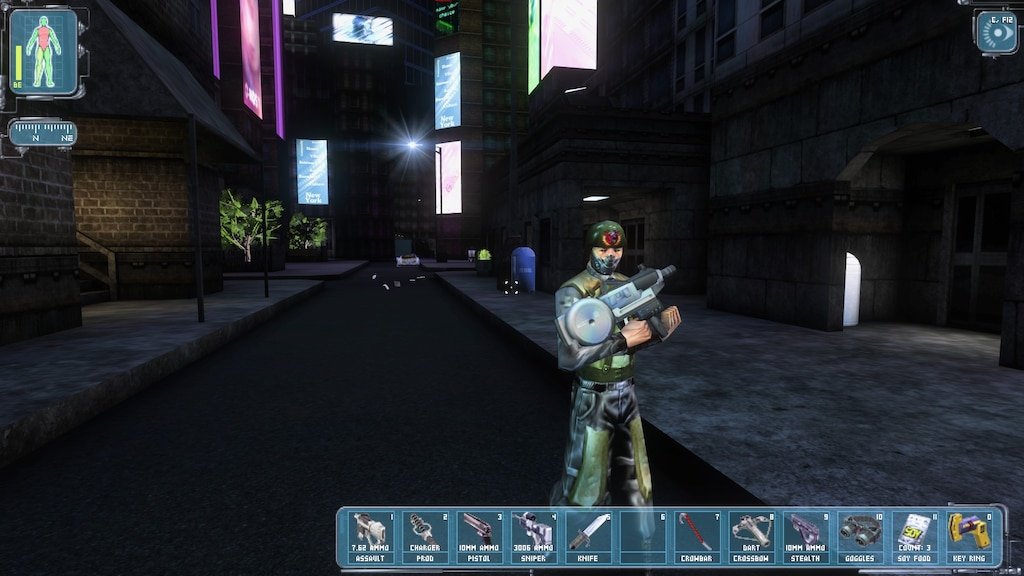
The true genius of Deus Ex lies in its Non-Linear Level Design. Most games give you a key to a door; Deus Ex gives you a door and then tells you that you can pick the lock, hack the terminal next to it, blow the hinges off with a GEP gun, or crawl through a vent three blocks away to bypass the room entirely. This freedom creates a sense of Emergent Gameplay that still puts many modern “AAA” titles to shame. You aren’t just following a script laid out by a designer; you are improvising your way through a hostile world.
This extends deep into the Character Development system. Because you have limited skill points and augmentation slots, you have to commit to a playstyle early on. Are you a ghost who hides in the shadows, uses a silenced pistol, and disables security cameras from a distance? Or are you a walking tank with Subdermal Armor and a penchant for heavy explosives? The game doesn’t punish you for your choice, but it does force you to live with the consequences of your utility. If you don’t invest in Hacking, you better hope you have enough multitools or lockpicks to get through that back entrance.
The reactivity of the world is legendary. If you kill a specific NPC in the first act, the dialogue and story beats in the third act will shift significantly to acknowledge your bloodlust. Even small things, like wandering into the ladies’ restroom at your headquarters, result in a stern scolding from your boss later. Most of us fondly remember Manderley non-nonchalantly telling you “By the way Denton, stay out of the ladies restroom, that kind of activity embarrasses the agency more that it does you”. It creates a personal narrative that feels uniquely yours, making the world feel reactive and alive in a way that few games have managed since.
A World Drowning in Cyberpunk Atmosphere
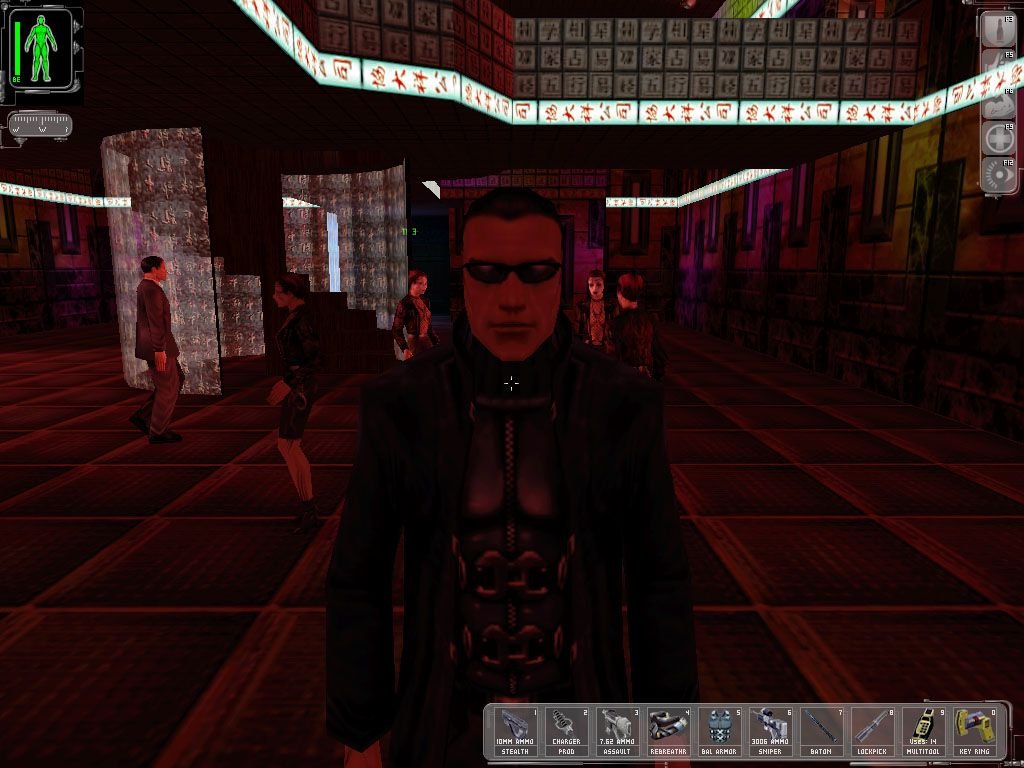
The atmosphere of Deus Ex is thick enough to cut with a combat knife. From the rain-slicked docks of Liberty Island to the neon-drenched, crowded streets of Hong Kong, the game captures a specific brand of Cyberpunk Noir that feels lonely, paranoid, and urgent. The lighting, while primitive by today’s standards, manages to evoke a sense of perpetual night, where the only thing brighter than the streetlamps is the glow of a computer terminal.
The music, composed by Alexander Brandon, is an absolute masterclass in electronic scoring. The soundtrack shifts perfectly between ambient exploration tracks that make your skin crawl and high-tension combat themes that get your heart racing. It perfectly complements the “trust no one” vibe of the narrative. Every location has a distinct sonic identity, from the synth-heavy vibes of the Lucky Money club to the oppressive, industrial hum of a Majestic 12 facility.
What’s truly wild about revisiting this game in the mid-2020s is how eerily prescient the writing was. The team at Ion Storm managed to bake almost every late-90s conspiracy theory into a cohesive plot that somehow feels more relevant today than it did twenty-six years ago. Discussions about AI Sovereignty, corporate overreach, income inequality, and the surveillance state are woven into the flavor text, “E-zines,” and public terminals scattered throughout the levels. It’s a world that feels lived-in and terrifyingly plausible, even when you’re fighting giant mechanical “Greays” or chatting with a rogue AI in a hidden basement.
The Rough Edges of Brilliant Design
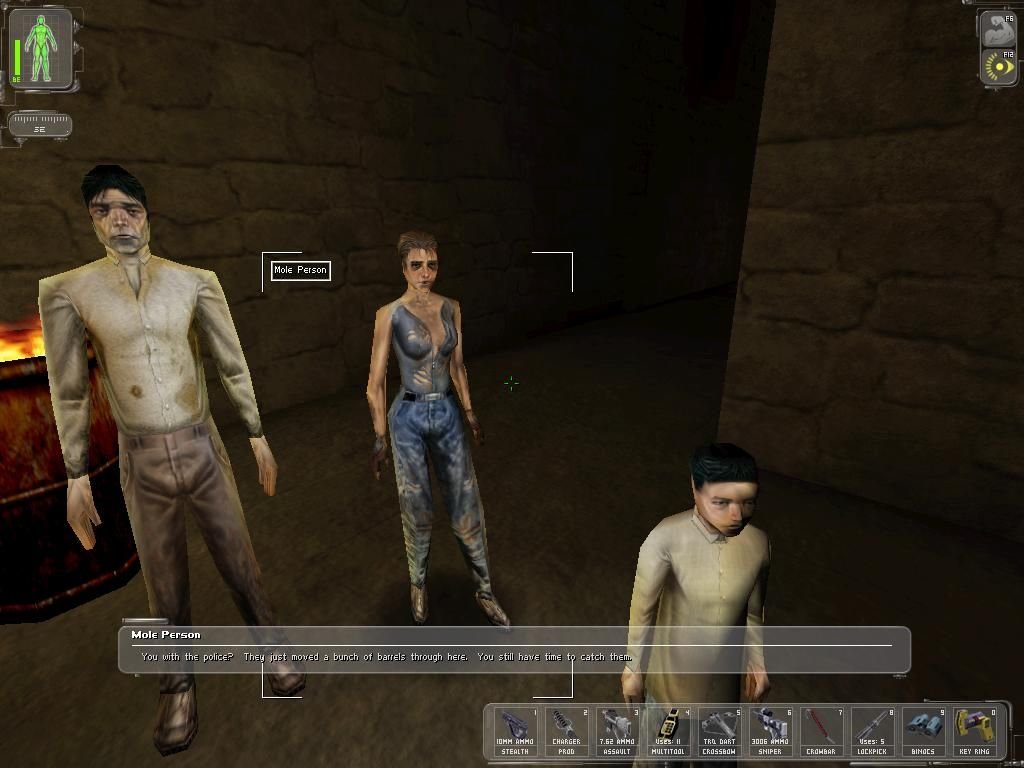
Now, being a helpful peer, I have to admit that the Combat Mechanics can feel a bit janky by modern standards. If you try to play this like a standard run-and-gun shooter, you’re going to have a frustrating time. The Reticule Bloom is incredibly aggressive, meaning JC’s aim is shaky and unreliable until you invest heavily in specific weapon skills. You have to stand still and let the reticule close if you want any hope of hitting a target at mid-range.
The enemy A.I. Patterns are also relics of their time. Sometimes they are tactical geniuses who will flush you out with grenades, and other times they will run face-first into a wall because they heard a soda can drop or saw a fire extinguisher explode. The stealth system, while revolutionary, is based heavily on light and shadow, and sometimes the line between “invisible” and “totally exposed” feels a bit arbitrary.
However, these quirks are part of the fundamental charm. They remind you that you are playing an RPG first and a shooter second. The game is less about the twitch-reflex of the shot and more about the tactical preparation leading up to the encounter. When you successfully clear a room without ever being seen, or talk your way out of a major boss fight using a hidden dialogue trigger you found by reading a discarded datapad, the satisfaction is immense. It rewards players who take their time and observe their surroundings.
A Legacy That Refuses to Fade
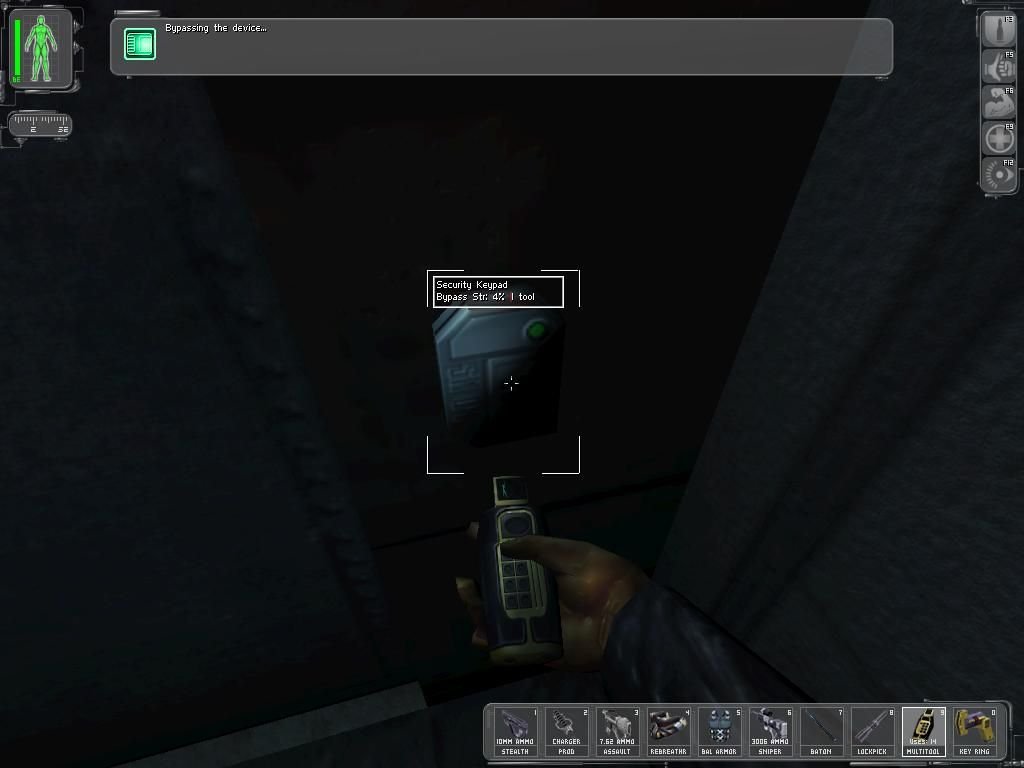
Deus Ex remains a high-water mark for the medium because it dared to give the player real power. It didn’t treat you like a consumer on a rail-ride; it treated you like a participant in a complex simulation. In a gaming landscape currently dominated by live-service checklists and map icons, the return to a game where you have to actually read a map and remember a keypad code is incredibly refreshing.
Whether you are a veteran returning to UNATCO for the hundredth time or a newcomer who just wants to see where the immersive sim genre truly began, Deus Ex is essential. It is a reminder that Ion Storm wasn’t trying to make a polished, safe product for the masses; they were trying to build a world that reacted to every whim and whisper of the player. Even decades later, its shadow looms large over the industry, proving that good design, a compelling atmosphere, and genuine player freedom are truly timeless. It’s a messy, brilliant, paranoid masterpiece that every gamer needs to experience at least once.
And if you played through the game already, or want to start another run after playing the game vanilla the first time, you can check out these mods and total conversions for the game:
The Nameless Mod (TNM)
This is widely considered the “gold standard” of total conversions. It doesn’t just add a level; it creates an entirely new world based on the culture of the old Deus Ex forums. You play as a fixer caught in a war between rival factions in a digital city. It features thousands of lines of professional voice acting, multiple branching paths, and a level of complexity that rivals Ion Storm’s original work. It’s a surreal, meta-commentary on the game itself while being a top-tier tactical RPG in its own right.
Download it here: The Nameless Mod on ModDB
Deus Ex: Revision
If you want to play the original game but feel it needs a coat of modern paint, Revision is the answer. This isn’t a new story, but a massive overhaul of the original levels, adding more detail, better lighting, and new architectural flourishes. It also bundles in high-resolution textures and a remastered soundtrack. It makes the world feel much more “lived-in” and dense without breaking the core gameplay loop we love.
Download it here: Deus Ex: Revision on Steam (Also available on GOG)
Deus Ex: GMDX (Give Me Deus Ex)
While Revision focuses on the look, GMDX focuses on the “feel.” This mod is all about mechanical refinement. It improves the A.I. Behavior, adds new weapon animations, and tweaks the skill system to make every choice feel more balanced. It adds “mantling” (climbing ledges), which fundamentally changes how you can navigate the environment. It’s often cited as the definitive way to play the game if you want the “classic” experience but with modernized controls and better physics.
Download it here: GMDX Official Site
2027
For those who want a prequel-style experience that feels incredibly professional, 2027 is a must-play. It takes place several years before the events of the original game and features a new protagonist, new weapons, and a highly detailed world that focuses heavily on the early days of human augmentation. The level design is exceptionally tight, leaning into the “multiple solutions for every problem” philosophy that made the original so famous.
Download it here: 2027 on ModDB
Nihilum
This is a massive, story-driven expansion where you play as a different agent altogether during a parallel timeline. Nihilum features entirely new locations, including a very impressive hub in Hong Kong and several secret labs. The voice acting and custom assets are high quality, and it manages to capture that specific “Ion Storm” vibe of corporate espionage and shadowy laboratories perfectly. It’s a great way to get that “first time playing Deus Ex” feeling all over again.
Download it here: Nihilum on ModDB