
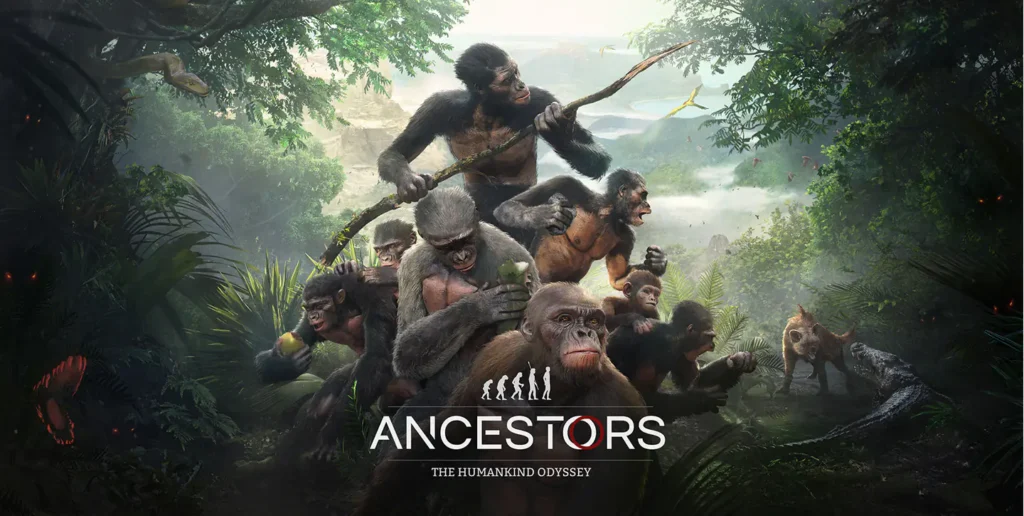

In the modern landscape of digital entertainment, players are often treated like royalty. We are ushered through golden gates of tutorials, guided by glowing waypoints, and shielded from the consequences of our own incompetence by generous checkpoints. Patrice Désilets, the creative mind behind the original Assassin’s Creed, decided to take a very different path with Panache Digital Games’ debut title, Ancestors: The Humankind Odyssey. Instead of holding the player’s hand, the game tosses them into the unforgiving jungles of Neogene Africa ten million years ago and essentially says, “Good luck; we won’t help you much.” This isn’t just a tagline; it is a fundamental design philosophy that makes Ancestors one of the most polarizing, frustrating, and yet singularly fascinating survival experiences of the last decade.
A Journey Through Deep Time
The premise is as ambitious as evolution itself. You begin not as a hero, but as a frightened, vulnerable hominid—a distant precursor to the human species. Your objective is simple in concept and Herculean in execution: survive, expand your clan, and evolve your lineage over eight million years until you reach the threshold of becoming Homo ergaster. The game spans an immense timeline, but it anchors this cosmic scale in the minute, tactile details of primitive life. Every action, from cracking a coconut to grooming a mate, is a step toward neurological maturity.
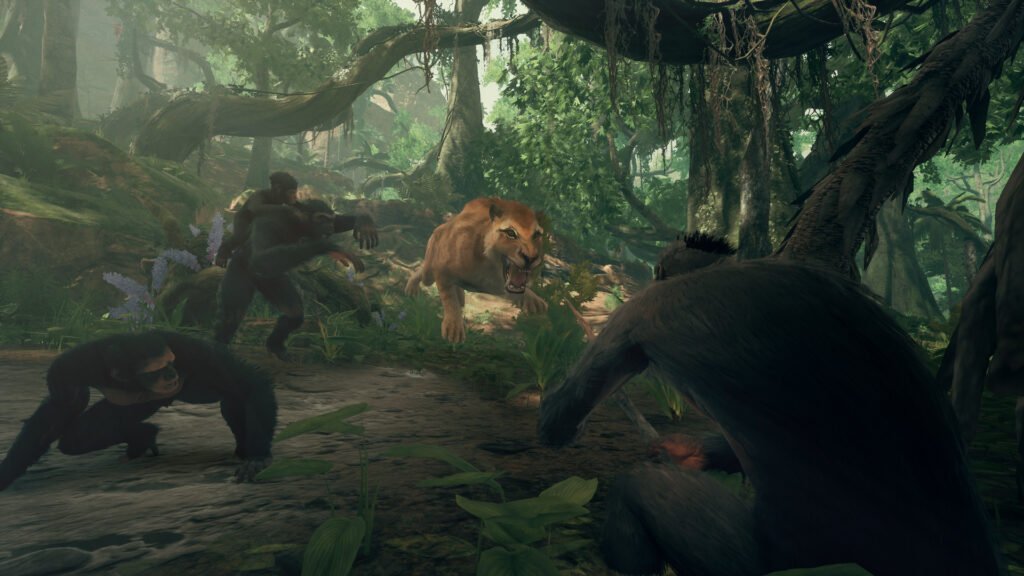
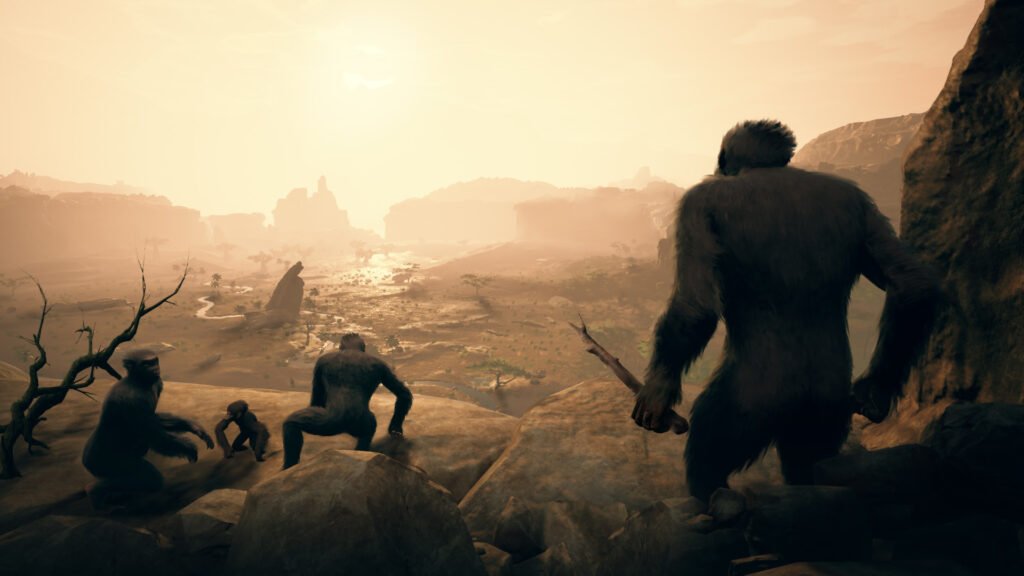
Visually and atmospherically, Ancestors is a triumph of prehistoric naturalism. The world is lush, vibrant, and terrifyingly vertical. The canopy of the African jungle is a playground of sunlight and swaying branches, providing a sense of freedom that few games achieve. However, the forest floor is a different story altogether. Down there, the “Fear of the Unknown” is a literal game mechanic. When a hominid enters an unexplored territory, the screen erupts in a cacophony of sensory overload—hallucinated teeth and distorted shadows represent the primal panic of a creature that realizes it is no longer at the top of the food chain. To conquer this fear, you must use your senses—smell, hearing, and intelligence—to identify the sources of the noise and the scent, essentially rationalizing the world around you until the fog of panic lifts.
The Mechanics of Mastery
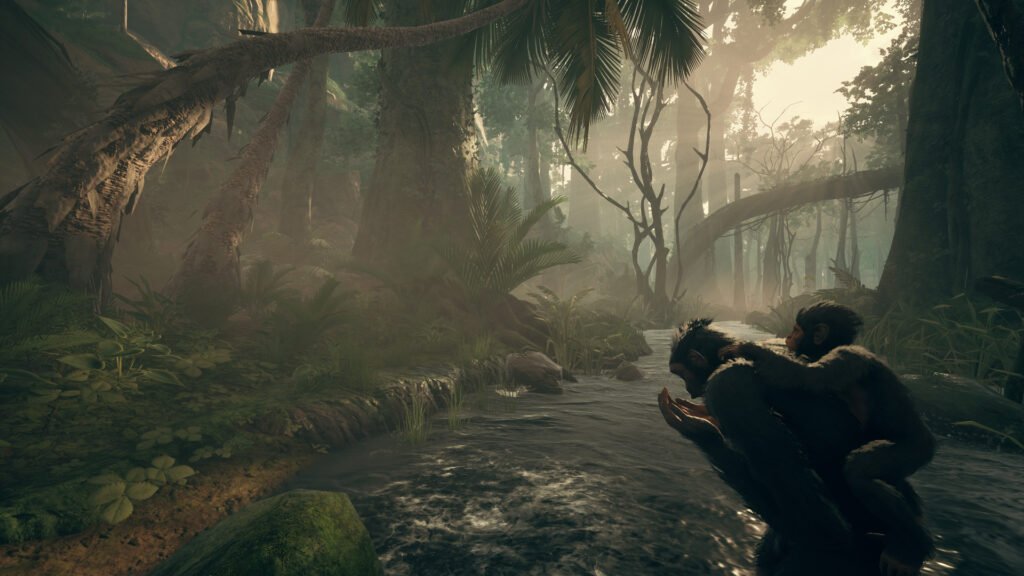
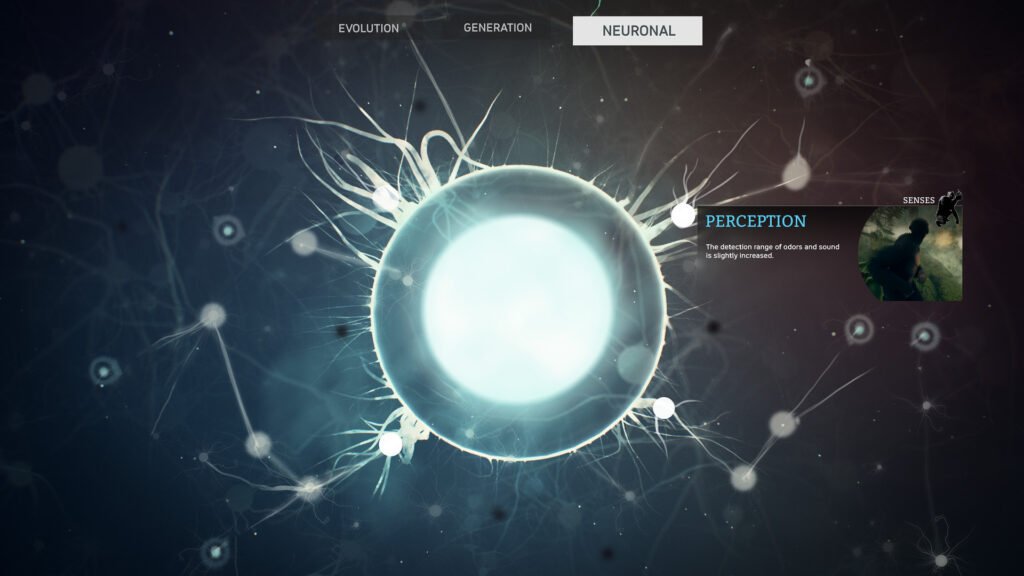
The core gameplay loop revolves around the development of the Neuronal Network, a skill tree that represents the evolving brain of your species. This is perhaps the game’s most brilliant translation of theme into mechanic. You do not gain experience points by killing enemies or completing quests; you gain neuronal energy by simply doing. Walking through water develops your balance; carrying heavy objects with two hands eventually leads to bipedalism; repeatedly hitting a rock against a stick might eventually result in the discovery of a sharpened tool.
However, the game demands a level of patience that many modern players may find intolerable. Progress is not permanent by default. To “lock in” your discoveries, you must pass through generations. This requires having offspring, reinforcing specific neurons, and then jumping forward fifteen years. The elders die, the adults become elders, and the children become the new adults. If you fail to protect your infants or lose too many clan members before a generation leap, your hard-earned progress can vanish into the mists of time. This creates a high-stakes environment where a single mistake—a mistimed jump from a redwood or a sudden ambush by a Machairodus (saber-toothed cat)—can set your species back thousands of years.
The Struggle for Survival
The combat system is a huge part of the game’s “figure it out” mentality. There is no attack button in the traditional sense. Instead, combat is a timing-based reflex mini-game. When a predator lunges, you must hold a button to enter a state of focused anticipation and release it at the exact moment a chime sounds to either dodge or counter-attack. In the early game, you are almost always the prey. It takes millions of years of evolutionary leaps and the development of group mimicry skills before you can truly turn the tables and hunt the monsters that once haunted your dreams.
Critics and players alike have rightfully pointed out that Ancestors can be an immense grind. The repetition of certain tasks—grooming, mating, and basic tool-making—can become tedious over the dozens of hours required to reach the end of the game. The controls are also notoriously clunky, often using the same button for multiple contextual actions, which can lead to tragic accidents. Yet, there is an undeniable magic in the “Eureka!” moments. The first time you successfully use a basalt chopper to sharpen a stick, or the first time your clan stands upright to peer over the tall grass of the savannah, you feel a genuine sense of accomplishment that few scripted games can provide.
An Unconventional Legacy
Ultimately, Ancestors: The Humankind Odyssey is less of a traditional video game and more of a grand social and biological experiment. It asks whether we, as modern humans, still possess the ingenuity and grit of our ancestors. It is a game that respects the player’s intelligence by refusing to explain itself, forcing you to rely on trial, error, and intuition. While the mechanical friction and repetitive loops will drive many away, those who persevere will find a deep, meditative experience that offers a profound perspective on the sheer improbability of our own existence. It is a flawed masterpiece, a beautiful slog, and a reminder that before we could reach for the stars, we first had to learn how to walk.