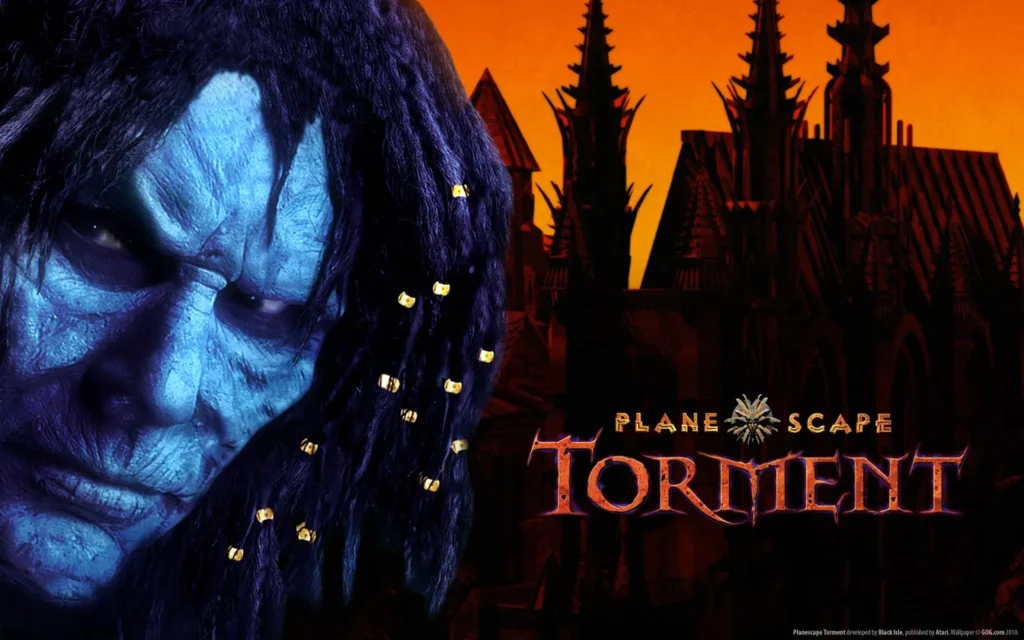

Release Date: December 10, 1999 Developer: Black Isle Studios
Get It On: GOG
If you ask a certain breed of RPG fan to name the greatest story ever told in gaming, they won’t point you toward the cinematic polish of The Last of Us or the sprawling choices of Baldur’s Gate 3. Instead, they’ll probably point you toward a weird, grime-covered relic from 1999 that begins in a morgue and features a floating, talking skull as your best friend.
I’m talking, of course, about Planescape: Torment. Developed by Black Isle Studios back in the golden age of isometric RPGs, this game didn’t just break the rules of the genre—it took those rules, set them on fire, and then asked the fire how it felt about the concept of mortality.
“What Can Change the Nature of a Man?”
Most RPGs start with a hero. You’re the “Chosen One,” the “Dragonborn,” or the “Commander.” In Planescape: Torment, you are The Nameless One. You wake up on a cold stone slab in the Mortuary, covered in scars, with zero memory of who you are. The twist? You can’t die. Well, you can, but you just wake up again.
This isn’t a game about saving the world. The world of Planescape (a Dungeons & Dragons setting) is far too vast, weird, and indifferent to be “saved.” Instead, this is a deeply personal, philosophical, and often heartbreaking quest to discover why you can’t die and what you’ve done with your past lives. The central question of the game—”What can change the nature of a man?”—isn’t just a bit of flavor text; it’s the core of every interaction you have.

A World Like No Other
Forget your standard “Elves in the woods” and “Orcs in the caves” tropes. Torment takes place primarily in Sigil, the City of Doors. It’s a metropolis located on the inside of a giant donut floating above an infinite spire at the center of the multiverse.
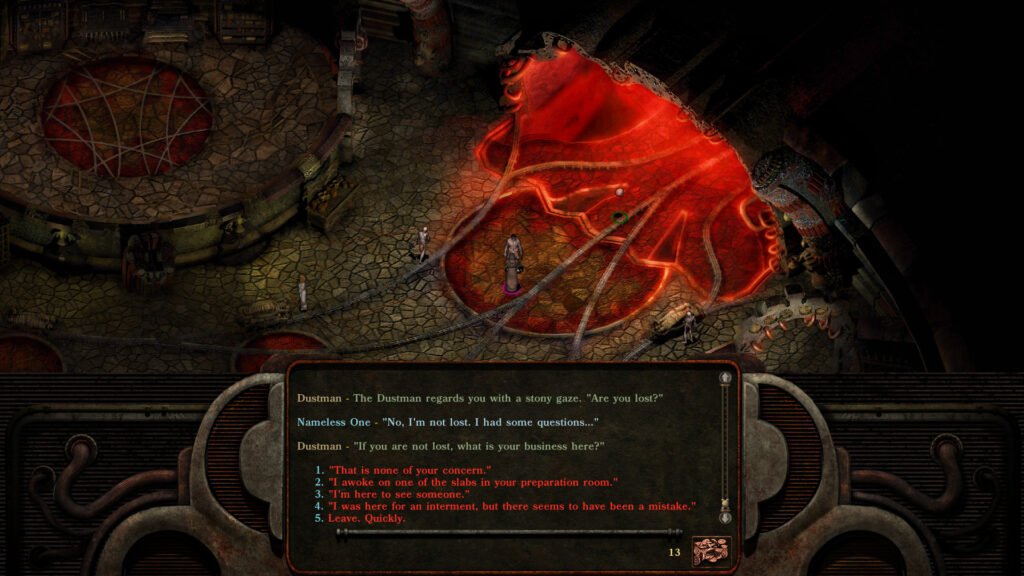
In Sigil, belief is power. If enough people believe something, it becomes true. You’ll encounter factions like the Dustmen, who believe life is just a transition to the “True Death,” or the Sensates, who believe the only way to understand the multiverse is to experience every possible sensation.
The environment is ugly, industrial, and bizarre. It’s a place where you might find yourself negotiating with a giant sentient tree or trying to solve a puzzle involving a pregnant street (yes, a literal street that is having a baby). It’s refreshing because even 25 years later, there is still nothing that looks or feels quite like it.
The Weirdest Party in Gaming History
Your companions in Torment are legendary. You won’t find any brooding paladins or manic pixie dream girls here. Instead, you get:
- Morte: A floating, sarcastic skull who fights by biting people and “taunting” them with insults so foul they lose their combat focus.
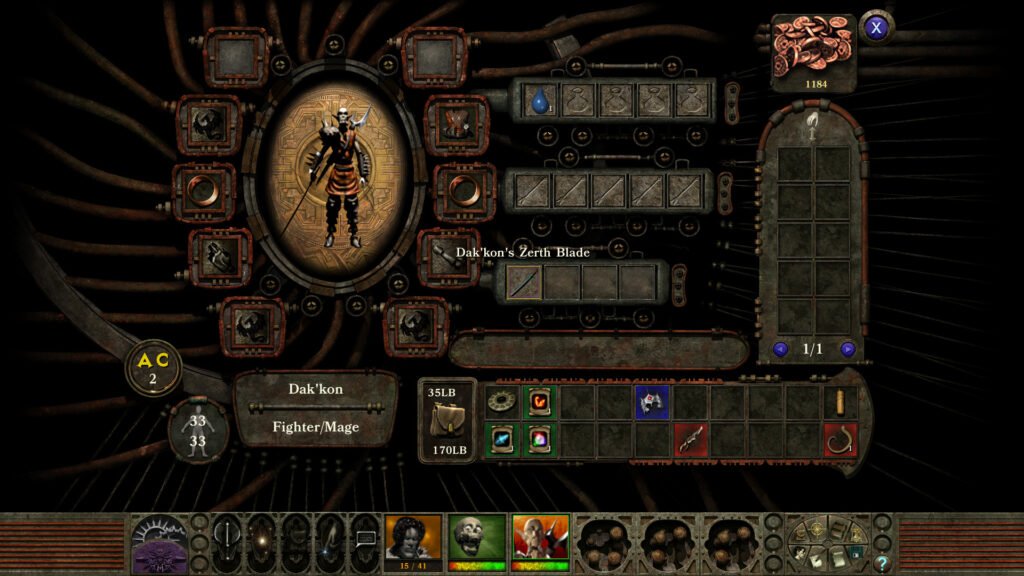
- Dak’kon: A Githzerai warrior whose blade is made of “reshaped chaos” and is literally powered by his thoughts and religious doubts.
- Ignus: A pyromaniac wizard who is perpetually on fire and serves as a living portal to the Elemental Plane of Fire.
- Fall-at-Grace: A succubus who is a chaste priestess and runs an “Intellectual Brothel” where people pay to talk about philosophy.
The banter between these characters isn’t just window dressing. Their personal arcs are woven into the main story so tightly that by the end, you’ll feel more attached to this group of freaks than almost any other cast in gaming.
The Gameplay: A Beautiful Mess
Let’s be real for a second: if you’re looking for tight, tactical combat, Planescape: Torment might frustrate you. It uses the old Infinity Engine (the same one used for Baldur’s Gate and Icewind Dale), but the combat often feels clunky and chaotic.
But here’s the secret: you barely have to fight.
Torment is a game that rewards the talkers. You can talk your way out of almost every major boss fight. You can solve deep-seated geopolitical conflicts in the outer planes through a well-placed logic trap. You can even gain “Experience Points” just by having a profound realization about your own soul.
The writing is the real star here. We’re talking about a script that is over 800,000 words long. It’s dense, poetic, and incredibly smart. It treats the player like an adult, tackling themes of regret, the burden of immortality, and the way our actions ripple through the lives of others across centuries.
The Legacy of the Nameless One
Why does this game still matter in 2026? Because it proved that games could be high art without sacrificing their “game-ness.” It showed that a narrative-heavy RPG didn’t need a massive world map if it had massive ideas.
Games like Disco Elysium owe their entire existence to Planescape: Torment. That concept of “text-as-gameplay” and “character-as-philosophy” started right here in the smoggy streets of Sigil.
Why You Should Play It (The Enhanced Edition)
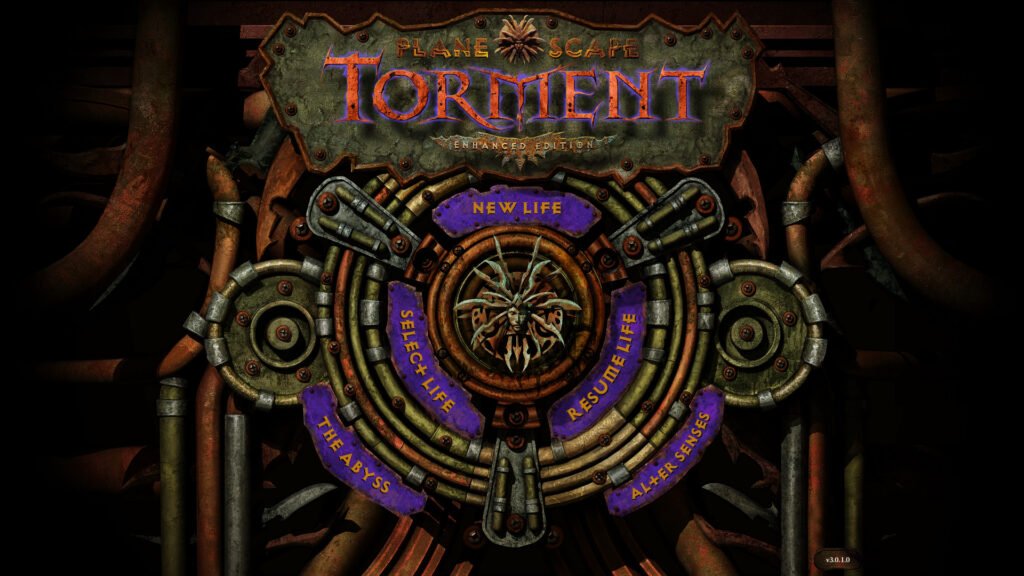
If you’re going to dive in, grab the Enhanced Edition by Beamdog. It cleans up the UI, allows for modern resolutions, and fixes some of the more egregious bugs from the 90s without touching the perfect script.
Tips for Newbies:
- Pump your Wisdom stat: In most RPGs, Wisdom is for Clerics. In Torment, Wisdom increases the amount of XP you gain and unlocks the best dialogue options and “memories.”
- Read everything: Don’t skip the dialogue. The game is basically a visual novel with a few bits of walking and clicking. If you don’t like reading, you’re going to have a bad time.
- Talk to your party: Use the “talk” icon on your own companions frequently. Their stories evolve as yours does.
Final Verdict
Planescape: Torment is a masterpiece that demands your patience and your brainpower. It’s not a “fun” game in the way Call of Duty is fun; it’s an engrossing experience that will stick in the back of your mind for years after the credits roll. It’s a reminder that even in a world of infinite planes and magic, the most interesting thing in the universe is the human heart—and the scars we leave upon it.
It’s weird, it’s wordy, and it’s wonderful. Go play it and find out what can change the nature of a man.