
If you have spent any time in the RPG community over the last two decades, you have undoubtedly encountered a specific type of gamer. You know the one—they usually have a faraway look in their eyes, they probably mutter about “lore” and “immersion,” and they will, without provocation, tell you that The Elder Scrolls III: Morrowind is the greatest game ever made. For years, I thought these people were just blinded by nostalgia, clinging to a 2002 relic because they couldn’t handle the streamlined polish of Skyrim. But then, I actually sat down and let the Silt Strider take me to Balmora. Now, here I am in 2026, writing a thousand-word love letter to a game that is technically older than some of the developers currently working at Bethesda.
There is something hauntingly beautiful about the island of Vvardenfell. It’s not the “Disney-fied” fantasy of the games that followed it. It is a harsh, alien, and deeply weird place where giant mushrooms serve as wizard towers, the police wear armor made of bug shells, and a giant volcano constantly vomits ash onto the landscape. If you are tired of generic medieval forests and dragons that feel like they came off an assembly line, Morrowind is the antidote. It is a masterpiece of world-building that refuses to hold your hand, and honestly, that’s exactly why we still love it.
The Alien Atmosphere of Vvardenfell
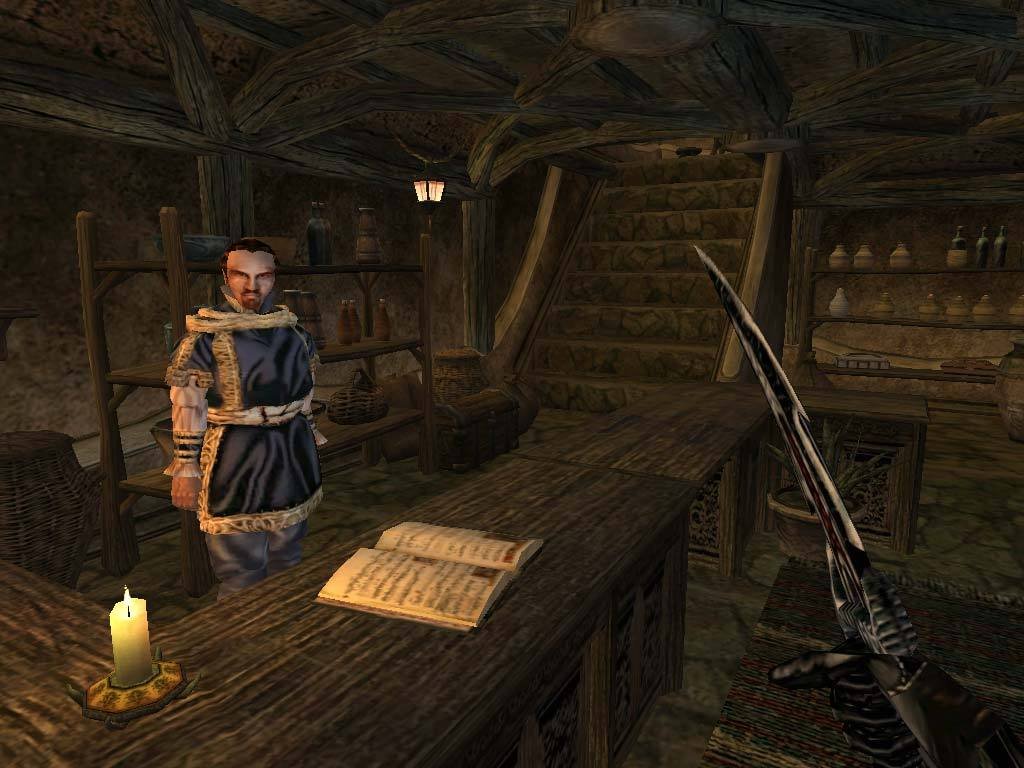
The first thing that hits you when you step off the boat in Seyda Neen is the sound. It’s not just the sweeping, iconic score by Jeremy Soule—though that certainly helps—it’s the environmental ambience. You hear the low, mournful groan of a Silt Strider in the distance, a sound that immediately tells you that you aren’t in Kansas anymore. Morrowind doesn’t feel like it was designed for the player; it feels like a real place that existed long before you arrived and will continue to rot long after you’re gone.
The geography itself is a character. You have the lush, swampy Bitter Coast, the desolate and wind-swept Ashlands, and the bizarre Grazelands. Most modern open-world games feel like theme parks, where every ten feet there is a “point of interest” designed to give you a dopamine hit. Morrowind is different. It’s lonely. It’s vast. It’s dangerous. When you’re caught in a Blight Storm in the middle of the night with no torch and three Cliff Racers screaming over your head, you feel a genuine sense of survivalism that modern RPGs often sacrifice for “user experience.”

No Quest Markers, No Problem
Let’s talk about the boldest design choice in the history of the series: the complete lack of a Quest Marker. In 2026, we are used to a glowing compass needle telling us exactly where to stand to trigger a cutscene. In Morrowind, your “map” is a handwritten Journal filled with directions like, “Head north from the bridge, look for a rock that looks like a thumb, then turn left at the burnt tree.”
At first, this is infuriating. You will get lost. You will end up in a cave three miles away from your actual objective. But something magical happens when you stop looking at a UI element and start looking at the world. You begin to recognize landmarks. You learn the layout of the Vivec City cantons. You actually pay attention to what the NPCs are saying because your life literally depends on it. This creates a level of Environmental Literacy that is virtually non-existent in modern gaming. When you finally find that hidden ruin in the mountains, the sense of accomplishment is ten times greater than if you had just followed a GPS line.

The Infamous Dice-Roll Combat
We have to address the elephant in the room, or rather, the mudcrab in the swamp. The combat in Morrowind is the biggest barrier to entry for new players. It is based on Dungeons & Dragons style dice rolls. You can be standing right in front of a rat, swinging your iron longsword with all your might, and you will “miss” five times in a row because your Long Blade skill is only 15.
From a modern perspective, this feels “broken.” But if you lean into the RPG mechanics, it’s actually brilliant. Morrowind isn’t an action game; it’s a simulation of your character’s growth. When you start, you are a pathetic nobody who can barely tie their own shoes. By the end of the game, after you’ve invested in your Attributes and Skills, you become a literal god who can delete enemies with a single flick of the wrist. The progression feels earned. You aren’t powerful because you’re good at pushing buttons; you’re powerful because you built a character that knows how to fight. It turns every early-game encounter into a high-stakes gamble, making that first enchanted weapon you find feel like a gift from the heavens.

Lore, Lies, and Living Gods
The narrative of Morrowind is where the game truly separates itself from the pack. You are the Nerevarine, a reincarnated hero destined to defeat Dagoth Ur and save the island. Standard stuff, right? Wrong. The game constantly asks you if you actually are the Nerevarine, or if you’re just a pawn being manipulated by the Imperial Blades to destabilize the local government.
The political landscape is a tangled web of the Three Great Houses: the honorable Redoran, the sneaky Hlaalu, and the completely insane, mushroom-dwelling Telvanni. Then you have the Tribunal Temple, a religion built around three “living gods”—Vivec, Almalexia, and Sotha Sil—who might just be frauds who stole their power. The lore isn’t just flavor text found in dusty books; it’s the driving force of the world. Vivec himself is one of the most complex characters in gaming history—a poet, a warrior, a liar, and a god who sits in a palace while a meteor hangs suspended over his city as a literal threat to his followers. It’s weird, it’s dense, and it’s fascinating.
Speaking of Dagoth Ur, he has to be one of the coolest villains in gaming, and the man can sing and dance like no other!
The Ultimate Power Trip: Spellmaking and Levitation
If there is one thing I miss in modern Elder Scrolls titles, it’s the absolute freedom of the Magic System. Morrowind lets you create your own spells, and the game doesn’t care if you break the balance. Want to create a spell that lets you jump across the entire map in a single bound? Go for it (just remember to pack a “Slowfall” spell for the landing). Want to Levitate over a city and rain fire down like a vengeful deity? The game encourages it.
The removal of Levitation in later games was a tragedy. In Vvardenfell, verticality is everywhere. The Telvanni wizards don’t even put stairs in their towers because they figure if you can’t fly, you aren’t worth talking to. This level of mechanical freedom makes you feel like you are truly mastering the laws of reality. When you combine this with the Alchemy loop—where you can create potions that boost your intelligence, which allows you to create even stronger potions until you have the brainpower of a supercomputer—you realize that Morrowind is a playground for the creative mind.

The Persistent Charm of the “Jank”
Does the game have bugs? Oh, absolutely. It’s a Bethesda game from the early 2000s; it’s held together by duct tape and prayers. You will see NPCs walking into walls. You will see Cliff Racers clipping through mountains. You will occasionally experience a crash that sends you back to the desktop.
But in a weird way, the Technical Flaws add to the charm. There is a sense of “anything can happen” that you don’t get in more polished experiences. The community has spent twenty years fixing these issues with massive projects like OpenMW, which brings the game into the modern era with widescreen support and stability. The fact that fans are still rebuilding this game’s engine from scratch in 2026 tells you everything you need to know about its staying power.
Expanding the Prophecy: The Modding Renaissance
If you think the base game is impressive, you haven’t seen anything until you dive into the modern Modding Scene. The crown jewel of this community is undoubtedly Tamriel Rebuilt. This is a project of staggering scale, aiming to add the entire mainland of the Morrowind province to the game, as originally intended before development constraints forced Bethesda to stick to the island of Vvardenfell. It’s not just empty land, either; it’s filled with voice acting, unique quests, and sprawling cities that rival the base game in quality. Walking across the Thirr River into lands that have been under construction for decades is a religious experience for any long-term fan. It transforms the game from a masterpiece into a seemingly infinite world of discovery.
Then there are overhauls like Morrowind Rebirth, which is essentially a “Director’s Cut” of the entire game. It reworks cities to feel more populated and grand, tweaks the game’s balance to stop you from becoming an accidental god too quickly, and adds hundreds of new items and enemies. For those who want the classic experience but with a modern engine’s reliability, OpenMW is the gold standard, providing a smooth, bug-free foundation that allows for massive draw distances. These mods aren’t just additions; they are a testament to the fact that the community refuses to let this game die. They ensure that even in 2026, a new player can step into Morrowind and find a world that feels as fresh and terrifying as it did in 2002.
The Verdict: A World Worth Losing Yourself In
At the end of the day, Morrowind is about Immersion. It’s about the feeling of being an outsider in a land that hates you, and slowly, through grit and curiosity, making it your own. It doesn’t treat you like a consumer who needs constant hand-holding; it treats you like an adventurer who is capable of failure.
Whether you are joining the Morag Tong to become a legal assassin, exploring the clockwork mysteries of the Dwemer, or just trying to find a pair of pants that don’t look ridiculous, Vvardenfell offers an experience that has never been replicated. It is a dense, philosophical, and uncompromising RPG that proves that “better graphics” don’t always mean “better game.” If you can look past the dated visuals and the dice-roll combat, you will find a world that is more alive than almost anything released in the last decade.