
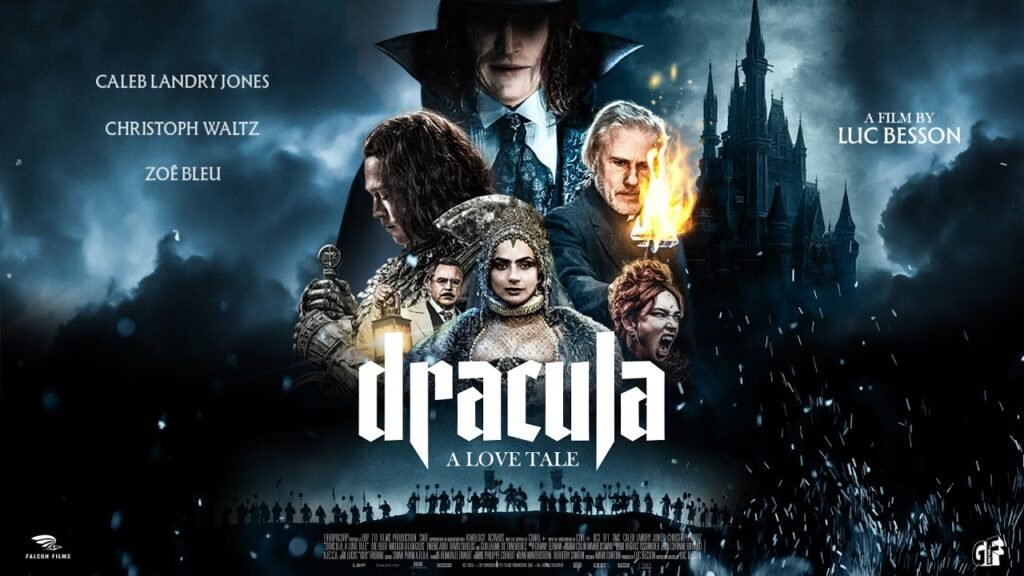

In a year that has seen the vampire myth revisited with terrifying brutality in Robert Eggers’ Nosferatu, Luc Besson has taken a decidedly different path. His latest spectacle, Dracula: A Love Tale, is not interested in jump scares or the claustrophobia of the crypt. Instead, Besson has crafted an operatic, visual feast that places eternal devotion above gothic dread.
If you are walking into the theater expecting a traditional horror movie, you may find yourself surprised—but that is exactly what Besson intended.
A Romance First, a Monster Movie Second
While the film opens with the bloody origins of Vlad the Impaler, it quickly sheds its horror trappings to become a sweeping period romance. Set largely in Belle Époque Paris rather than the dreary London of the novel, the film focuses on the soul’s desperate search for its other half.
Besson himself addressed the tonal shift during the film’s press tour, famously stating:
If you want a traditional horror movie, look somewhere else. This is a story about the disease of living without love.
This philosophy is baked into every frame. The “horror” elements are treated with a campy, surrealist flair—such as the infamous scene featuring a magical perfume and a mob of enchanted nuns—while the romantic beats are handled with earnest, heart-wrenching sincerity. It is a film for the romantics, focused on the melancholic ache of a man who has waited 400 years to say a single name.
The film’s pivot toward romance only works because of its two powerhouse leads.
- Caleb Landry Jones (Dracula): Jones delivers a transformative performance. He shies away from the “suave aristocrat” trope, instead playing Dracula as a “sad wet cat”—a fragile, tormented being fueled by grief. His ability to switch between a frenetic, ancient warlord and a vulnerable lover is nothing short of mesmerizing.
- Zoë Bleu (Elisabeta / Mina): Playing a dual role is no small feat, but Bleu anchors the film’s emotional stakes. Her chemistry with Jones is palpable; she embodies a sense of “soul-recognition” that makes the reincarnation plot feel grounded and tragic rather than purely fantastical.
Complementing them is the legendary Christoph Waltz as a monster-hunting priest. Waltz provides the perfect analytical counterweight to the leads’ boundless passion, bringing his trademark wit and gravitas to a role that could have easily been a caricature.
Dracula: A Love Tale is a fever dream of gothic aesthetics, lush costumes, and a soaring Danny Elfman score. It is polarizing, bizarre, and unashamedly sentimental. While it may not satisfy those looking for “The King of Vampires” to be a terrifying predator, it succeeds as a lush exploration of the idea that love is the only thing truly immortal.