
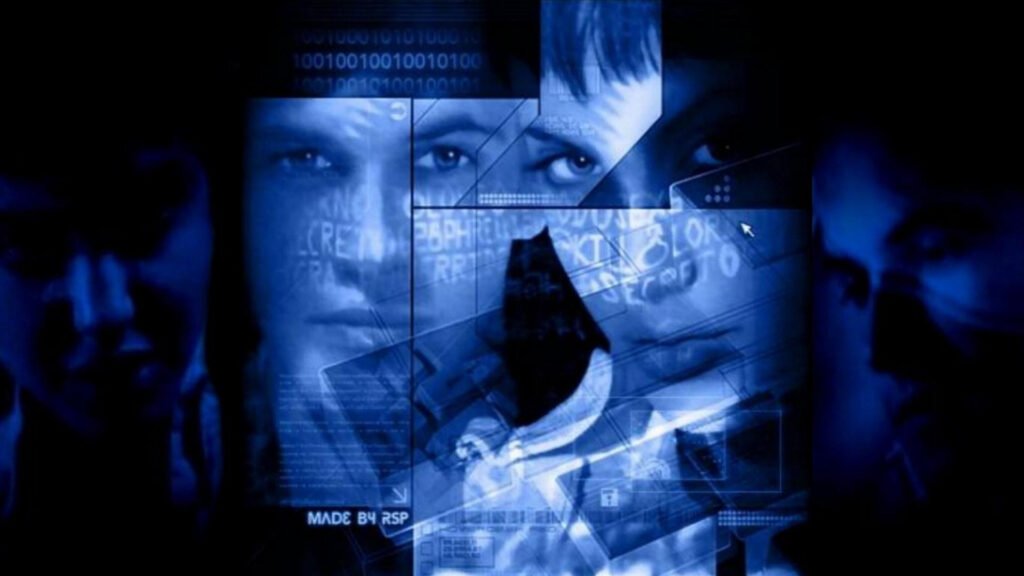

Released in 1995, Iain Softley’s Hackers arrived at a peculiar crossroads in cultural history. The World Wide Web was barely a toddler, “dialing up” involved a series of screeching electronic protests, and the general public viewed the internet as a mysterious, vaguely threatening frontier. Decades later, Hackers stands not as a realistic depiction of computer science, but as a vibrant, stylish, and unintentionally hilarious monument to 90s counterculture.
The film follows Dade Murphy (Jonny Lee Miller), a legendary teenage hacker who was banned from using computers after crashing over a thousand systems at age 11. Now eighteen and newly arrived in New York City, Dade—alias “Crash Override”—quickly falls in with a ragtag group of elite high school hackers. Among them is Kate Libby (Angelina Jolie), the fiercely competitive “Burn,” and a cast of colorful characters with handles like “Cereal Killer,” “Lord Nikon,” and “Phantom Phreak.”
The plot kicks into high gear when a young protégé accidentally stumbles into a high-level corporate embezzlement scheme orchestrated by a villainous security expert known as “The Plague” (played with delightful camp by Fisher Stevens). Framed for a virus that threatens to capsize an oil tanker fleet, the teens must use their combined skills to “Hack the Planet” and clear their names.
Aesthetic Over Accuracy
If you are looking for a realistic portrayal of coding, Hackers is not your movie. In the world of Softley’s film, hacking is a visceral, psychedelic experience. Instead of staring at lines of monochrome text, the characters navigate “The Gibson”—a 3D cityscape of glowing geometric towers and cascading data streams.
The film prioritizes style over substance in the best way possible. From the pulsating techno soundtrack featuring The Prodigy and Underworld to the avant-garde costume design (vinyl vests, rollerblades, and bleached hair), Hackers creates a curated reality. It’s a world where hackers don’t sit in dark basements; they hang out in neon-lit underground clubs and rooftop lofts, treating data intrusion like an extreme sport.
Despite its technical absurdities, Hackers captured something profound: the spirit of curiosity.
- The Ethos: The film emphasizes the “Hacker Manifesto”—the idea that information should be free and that technology is a tool for the curious, not just the powerful.
- The Cast: This was a breakout role for a young Angelina Jolie, whose screen presence is undeniable even in her earliest work. The chemistry between the ensemble cast provides the film with a genuine heart that keeps it grounded amid the flashy visuals.
- The Visual Language: While the CGI is dated, its ambition is impressive. It tried to visualize the feeling of being connected to a global network before we had the vocabulary to describe it.
The Verdict: A Cult Classic
Hackers is a “maximalist” film. It is loud, colorful, and utterly sincere in its dorkiness. While modern audiences might chuckle at the sight of a “laptop” that looks like a heavy suitcase or the dramatic tension surrounding a 3.5-inch floppy disk, the film’s energy is infectious.
It serves as a reminder of a time when the digital world felt like a playground of endless possibility rather than a utility for social media and surveillance. It’s a neon-drenched fever dream that remains one of the most entertaining relics of the 1990s.